Hip labral tears have become one of the most common findings on MRI scans. If you’ve recently been told you have a torn labrum, it’s understandable to feel concerned. Many people immediately assume they’ve torn an important structure that can only be repaired with surgery.
The reality is often much more nuanced.
I’ve worked with many people who had MRI-confirmed hip labral tears and were able to return to hiking, golfing, weight training, and other activities without surgery. I’ve also seen people with very small hip labral tears experience significant pain, while others have surprisingly large tears and never know they’re there.
If the size of the tear alone determined your pain, those situations wouldn’t happen.
Just like arthritis, a labral tear is only one piece of the puzzle. The more important question is often why the labrum became overloaded in the first place.
What Is the Hip Labrum?
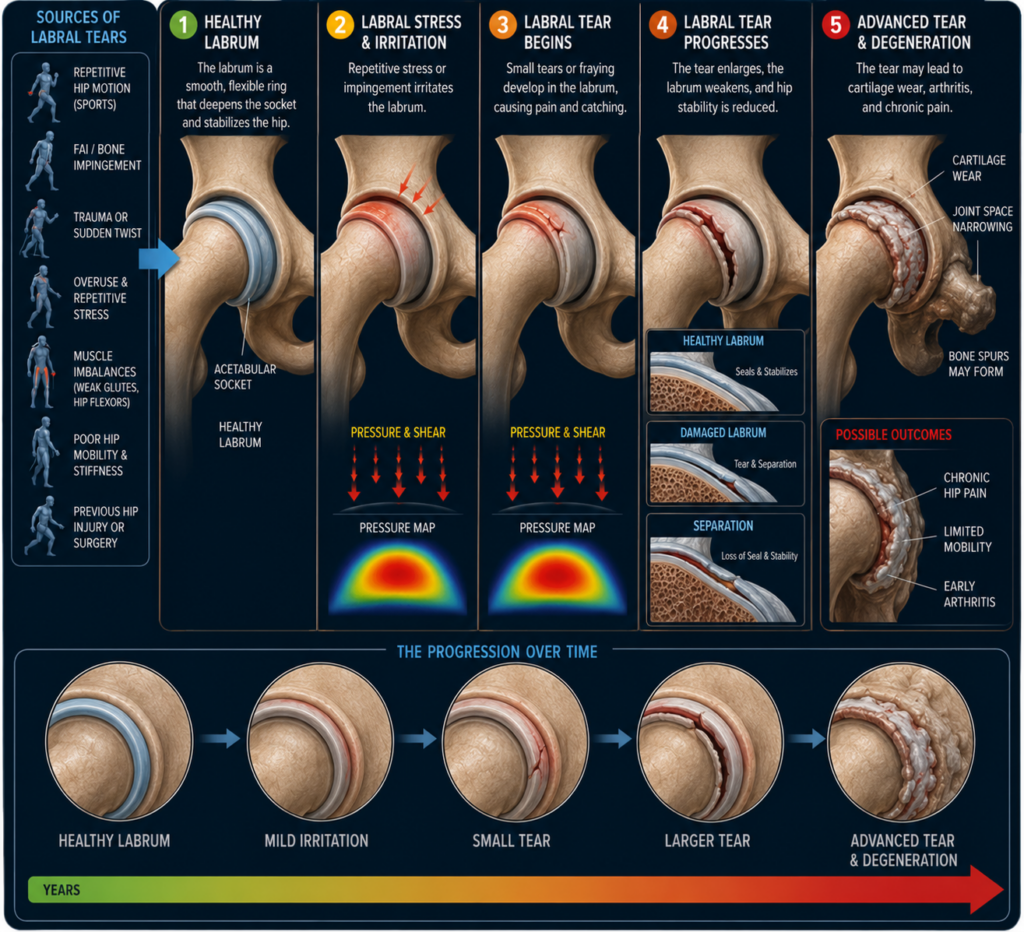
The labrum is a ring of fibrocartilage that surrounds the socket of your hip joint. Think of it as a gasket around the edge of the socket. It helps deepen the joint, improve stability, maintain joint fluid pressure, and distribute forces across the hip.
Every time you walk, squat, run, or climb stairs, your labrum helps the ball of the hip move smoothly within the socket.
When the labrum becomes torn, those mechanics can change. Some people notice clicking, catching, locking, or deep groin pain. Others simply experience stiffness or discomfort after prolonged sitting or activity.
Interestingly, many labral tears never produce symptoms at all.
Your MRI Doesn’t Explain Why the Tear Happened
One of the biggest misconceptions surrounding hip labral tears is that the tear itself is always the primary problem.
Imagine driving your car over a pothole every single day.
Eventually, the tire wears out.
Replacing the tire certainly fixes the damaged tire, but if you continue driving over the same pothole every day, the new tire begins wearing out as well.
The tear is often like the worn tire.
Our goal is to identify the pothole.
The Hip Doesn’t Function in Isolation
One of the principles that has shaped my treatment philosophy through years of studying SomaTraining is that no joint functions alone.
Every step begins at the foot before force travels through the ankle, knee, pelvis, spine, rib cage, and finally into the hip. The fascia surrounding these structures helps transmit force throughout the entire body, allowing movement to occur efficiently.
When one region loses mobility or stability, another region often has to compensate.
Sometimes the ankle becomes stiff after an old injury.
Sometimes the pelvis no longer rotates efficiently.
Sometimes spinal stiffness changes the way forces travel through the trunk.
Sometimes breathing mechanics alter core stability.
Individually these changes may seem small. Collectively they can place tremendous stress on the front of the hip, where many hip labral tears occur.
That doesn’t mean these movement patterns caused your tear. Labral tears can result from trauma, repetitive athletics, hip dysplasia, femoroacetabular impingement (FAI), or normal age-related changes. However, once a tear exists, improving how your body distributes force may reduce the stress continually placed upon that tissue.
Suggested Image: Whole-body kinetic chain or fascial continuity illustration.
Why Traditional Treatment Doesn’t Always Solve the Problem
Many treatment plans focus almost exclusively on the MRI findings.
Some patients receive injections to calm inflammation. Others begin strengthening exercises directed only at the hip. In more severe cases, arthroscopic surgery may be recommended to repair or trim the torn labrum.
These treatments certainly have their place.
The challenge is that they don’t always answer the bigger question.
Why is this portion of the hip continually being overloaded?
If abnormal movement patterns remain unchanged, excessive forces may continue passing through the joint, regardless of whether the labrum has been treated.
How We Approach Hip Labral Tears
At Colorado Hip Pain, we begin by evaluating the way your entire body moves.
Rather than looking only at the painful hip, we assess how your feet, knees, pelvis, spine, posture, and breathing mechanics work together. Frequently, the painful hip is compensating for dysfunction somewhere else in the movement chain.
Treatment is designed to restore more efficient movement throughout the body. Depending on your findings, this may include manual therapy to improve joint mobility, myofascial stretching to restore normal fascial tension, osteo-articular pumping techniques to encourage healthier joint mechanics, segmental strengthening to improve muscular coordination, and ELDOA exercises to optimize posture and reduce unnecessary compression throughout the kinetic chain.
Instead of chasing pain, we focus on improving the environment in which your hip functions.
When forces become better distributed, irritated tissues often become less irritated.
Does Every Labral Tear Need Surgery?
No.
Many people with labral tears improve substantially through conservative care. Research has shown that imaging findings alone do not determine who requires surgery. Factors such as symptoms, functional limitations, associated hip morphology, response to rehabilitation, and individual goals all play important roles in deciding the most appropriate treatment.
For individuals who eventually require surgery, improving movement quality beforehand often contributes to a smoother recovery afterward.
The goal isn’t to avoid surgery at all costs.
The goal is to make sure surgery is treating the right problem.
The Bottom Line
A hip labral tear is a diagnosis.
It is not necessarily the entire explanation for your pain.
At Colorado Hip Pain, we believe successful treatment begins by looking beyond the MRI. By improving how your entire body moves and distributes force, we often help reduce unnecessary stress placed on the hip and improve your ability to move with greater confidence.
Your labrum may be injured, you may have a hip labral tear.
But understanding why it became overloaded is often the key to lasting improvement.
