
Hip Labral Tear

Move Freely Again

Hip Labral Tear: Symptoms, Causes, and Treatment Options

A hip labral tear is an injury or structural change involving the labrum, the ring of fibrocartilage surrounding the hip socket. Labral tears can cause groin pain, clicking, catching or stiffness, but a tear found on MRI does not always mean it is the source of a person's hip pain.

What Is A Hip Labral Tear?

Hip labral tear symptoms can vary depending on the location and severity of the injury and the individual.

Common symptoms may include:

  • Deep pain in the hip or groin
  • Pain with hip rotation
  • Clicking or popping
  • Catching or locking sensations
  • Hip stiffness
  • Reduced range of motion
  • Pain getting in or out of a car
  • Pain sitting for extended periods
  • Pain during squatting
  • Discomfort during lunges
  • Pain with running
  • Pain during pivoting or cutting
  • Pain with certain athletic movements
  • A feeling of instability
  • Reduced confidence using the affected hip

Some people describe the pain as being deep inside the joint rather than on the surface of the hip.


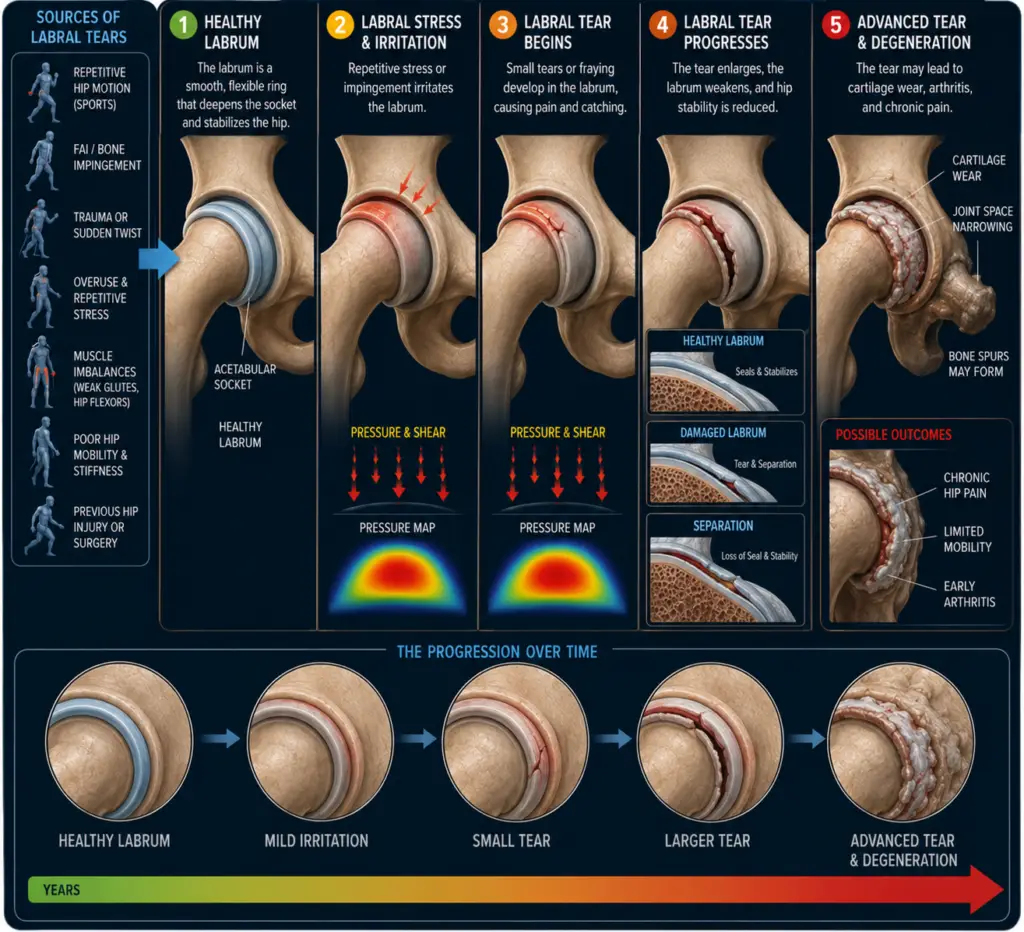
image of a hip with progressive labral tear.

What Causes a Hip Labral Tear?

There isn’t always one single cause.

Some labral tears develop following a specific injury. Others develop gradually as a result of repetitive loading or structural factors affecting the hip.

Potential contributors include:

Femoroacetabular Impingement

FAI occurs when the shape of the bones around the hip causes abnormal contact during certain movements.

Over time, this may place additional stress on structures within the joint, including the labrum.

Repetitive Athletic Movement

Sports involving frequent pivoting, rotation, kicking, deep squatting, or rapid changes of direction can place substantial demands on the hip.

Examples include:

  • Soccer
  • Hockey
  • Tennis
  • Basketball
  • Golf
  • Running
  • Martial arts
  • Dance

Trauma

A fall, collision, sudden twist, or other significant injury can damage structures within the hip.

Hip Dysplasia

Differences in the development or structure of the hip socket can alter how forces are distributed through the joint and may increase stress on the labrum.


Hip Labral Tear vs Hip Impingement

Hip labral tears and femoroacetabular impingement  (FAI) can occur together, but they are not the same condition.

FAI refers to a structural relationship between the bones of the hip that can result in abnormal contact during certain movements.

A labral tear refers to damage to the labrum surrounding the hip socket.

FAI may contribute to labral damage, but having one condition does not automatically mean you have the other.

Understanding the relationship between hip structure, movement, and symptoms is an important part of developing an appropriate treatment strategy.

Femoroacetabular Impingement →

Can a Hip Labral Tear Heal on Its Own?

The labrum has limited blood supply in many areas, which can affect its ability to heal after injury.

Whether symptoms improve without surgery depends on many factors, including:

  • The location and extent of the tear
  • The underlying cause
  • Hip structure
  • Movement patterns
  • Strength
  • Activity demands
  • Irritation of surrounding tissues
  • Individual response to treatment

A person may experience significant improvement in pain and function even when the structural tear itself remains visible on imaging.

That’s why our treatment system often focuses not only on the tear itself, but also on improving the individual’s ability to move and tolerate activity.

Can You Treat a Hip Labral Tear Without Surgery?

In some cases, conservative treatment may be appropriate.

Non-surgical management may include:

  • Activity modification
  • Progressive exercise
  • Strength training
  • Mobility work
  • Movement retraining
  • Manual therapy
  • Education
  • Home exercise programming
  • Gradual return to activity

The goal is not to promise that a torn labrum will repair itself.

Instead, conservative care focuses on reducing aggravating factors, improving physical capacity, and helping you progressively improve your movement mechanics.

For some people, this may allow them to continue participating in the activities they value without surgery.

What Exercises Should You Avoid With a Hip Labral Tear?

There isn’t a universal exercise list that everyone with a labral tear needs to avoid.

However, certain movements may aggravate symptoms in some individuals.

These can include positions involving:

  • Deep hip flexion
  • Significant internal or external rotation
  • Pivoting
  • Repetitive impact
  • High training loads
  • Combined hip flexion and rotation

That does not mean these movements are permanently off-limits.

Instead, the appropriate question is:

What movement can your hip tolerate right now, and how can that capacity be progressively developed?

A movement assessment can help identify which positions and activities are currently provoking symptoms and which can be gradually reintroduced.


Can Massage Help a Hip Labral Tear?

Massage does not repair a torn labrum.

However, massage therapy may be useful for addressing muscular tension or soft-tissue restrictions that contribute to discomfort or affect movement.

For that reason, manual therapy may be incorporated as one component of a broader rehabilitation strategy.

The emphasis remains on helping you develop the movement capacity and physical resilience needed outside the treatment room.


Our Integrative Approach to Hip Labral Tears

At Colorado Hip Pain, individualized programs may incorporate:

Manual Therapy

Hands-on techniques designed to address relevant soft-tissue and mobility restrictions.

Corrective Exercise

Movement strategies selected around your individual limitations.

ELDOA

Specific postural and myofascial exercises incorporated when appropriate.

Segmental Strengthening

Progressive strengthening focused on specific areas and movement patterns.

Mobility Restoration

Strategies designed to maintain or improve available movement.

Progressive Strength Training

Building the capacity necessary for your everyday activities and athletic goals.

Home Programming

Individualized exercises that help you continue working toward your goals between appointments.

Frequently Asked Questions About Hip Labral Tear

Does a hip labral tear always cause pain?

No. A labral tear found on an MRI does not automatically mean the tear is causing your hip pain. Research has identified labral abnormalities in people who have no hip symptoms, which means the imaging finding needs to be interpreted in context.Your symptoms, physical examination, mobility, strength and the activities that reproduce your pain all provide additional information. An MRI shows what the tissue looks like; it does not independently prove which structure is responsible for your hip pain.

Where does a hip labral tear usually hurt?

A symptomatic hip labral tear commonly causes pain in the groin or front of the hip. Some people also experience clicking, catching, locking or discomfort during movements involving deeper hip flexion or rotation.However, these symptoms are not unique to labral tears. FAI, osteoarthritis, muscular problems and other hip conditions can produce similar symptoms. Pain location and an MRI finding should therefore be considered together rather than using either one alone to determine the source of the problem.

Does clicking or popping in my hip mean I have a labral tear?

No. Clicking or popping does not automatically mean you have a hip labral tear. Hip noises are relatively common and can occur for several reasons, including movement of tendons and other soft tissues around the joint.The clicking becomes more clinically relevant when it is consistently painful, associated with catching or locking, or occurs along with other hip symptoms. Even then, imaging and clinical assessment may be necessary to determine whether the labrum is actually involved.

Can I squat with a hip labral tear?

Possibly. Having a hip labral tear does not automatically mean you need to permanently stop squatting. Deep hip flexion can aggravate symptoms in some people, but squat depth, stance, resistance and technique can significantly change the demands placed on the hip.Instead of simply classifying squatting as good or bad, the movement can often be modified to match your current tolerance. As symptoms improve and strength and movement capacity increase, greater depth or resistance may be gradually reintroduced.

Can I run with a hip labral tear?

Some people with a hip labral tear can continue running or successfully return to running. The decision should depend more on symptoms, function and load tolerance than on the MRI finding alone.Running volume, speed, hills, frequency and recovery all affect how much stress the hip must tolerate. If running consistently increases pain or produces prolonged symptoms afterward, temporarily modifying those variables while rebuilding strength and capacity may be more appropriate than assuming running must permanently stop.

What's the difference between FAI and a hip labral tear?

A hip labral tear involves damage to the fibrocartilage surrounding the hip socket. Femoroacetabular impingement (FAI) refers to a structural relationship between the femur and acetabulum that can create increased contact during certain hip movements.The two conditions can occur together. FAI may increase stress on the labrum in some individuals, but having FAI does not automatically mean you have a symptomatic labral tear, and finding a labral tear does not prove that FAI is responsible for your pain

Does a hip labral tear always require surgery?

No. A hip labral tear does not automatically require surgery. Many factors influence whether conservative treatment or surgical evaluation is appropriate, including symptoms, functional limitations, hip anatomy, cartilage health, activity goals and response to nonsurgical care.The presence of a tear on MRI alone should not determine the decision. Surgery becomes more relevant when significant pain or functional limitations persist despite appropriate conservative management and clinical evaluation suggests the labrum or associated structural pathology is contributing to the symptoms.

Scroll to Top