
Femoroacetabular Impingement | FAI

Move Freely Again

Femoroacetabular Impingement (FAI): What It Is and Why It Hurts

Femoroacetabular impingement (FAI) is a hip condition involving abnormal contact between the femur and acetabulum during certain movements, most commonly associated with cam, pincer, or combined morphology.

What Is Femoroacetabular Impingement (FAI)?

What Is Femoroacetabular Impingement?

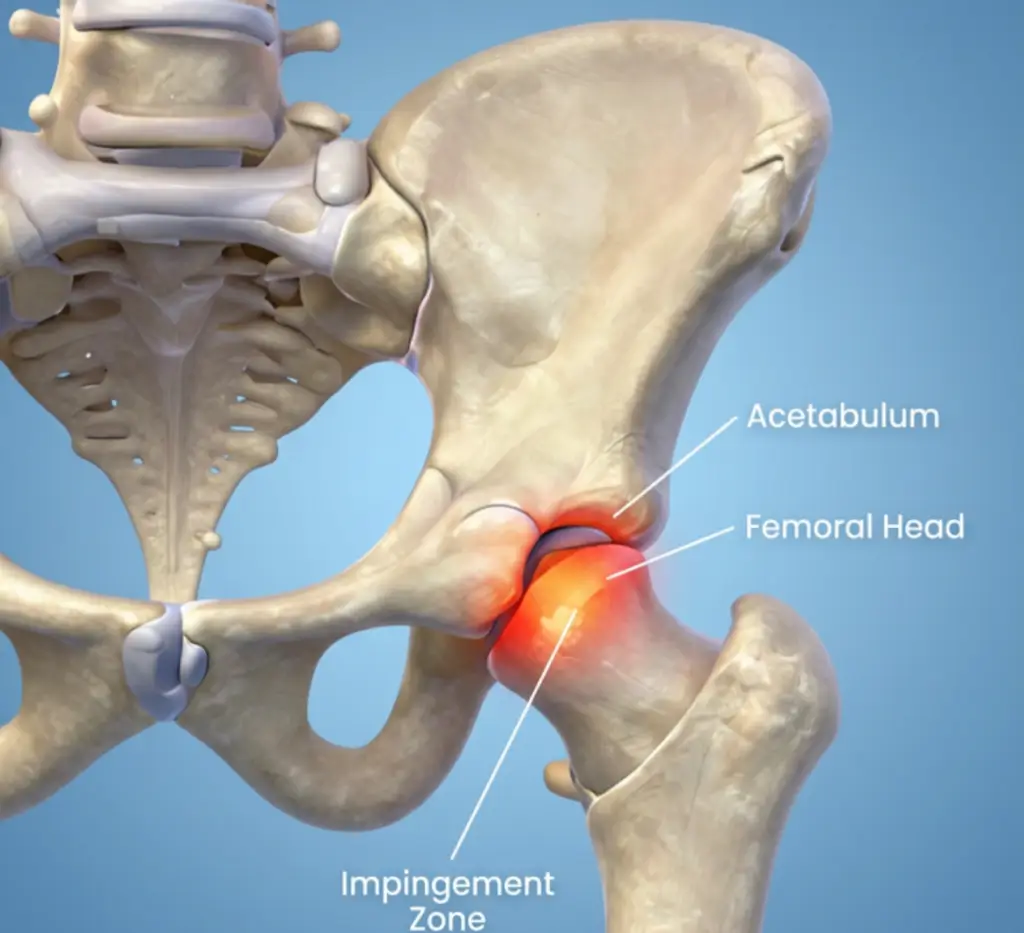
Femoroacetabular impingement, commonly called FAI or hip impingement, occurs when there is abnormal contact between the ball and socket of the hip joint during certain movements.

The hip is a ball-and-socket joint. The ball is the femoral head, located at the top of the thigh bone.The socket is the acetabulum, part of the pelvis. When the shape or orientation of these structures causes increased contact during certain positions, the movement of the hip can become restricted or painful.

FAI is generally classified into three categories:

Cam Impingement

A cam-type morphology involves extra bone or an altered shape around the femoral head-neck junction.

Pincer Impingement

A pincer-type morphology involves increased coverage of the femoral head by the acetabulum.

Combined FAI

Some people have characteristics of both cam and pincer morphology. Importantly, having the structural characteristics associated with FAI does not automatically mean you have painful FAI syndrome. Some people have these anatomical features without significant symptoms.

What Does Hip Impingement Feel Like?

FAI symptoms can vary considerably from person to person.

Common symptoms include:

  • Deep groin pain
  • Front-of-hip pain
  • Hip stiffness
  • Pain when bringing the knee toward the chest
  • Pain with squatting
  • Pain getting into or out of a car
  • Discomfort sitting for prolonged periods
  • Pain with running
  • Pain during cutting or pivoting
  • Reduced hip mobility
  • Clicking or catching
  • Pain during certain athletic movements
  • Discomfort with hip rotation

A common description is a pinching sensation deep in the front of the hip, particularly when the hip is positioned into deeper flexion or combined flexion and rotation.

However, symptoms alone cannot determine whether FAI is the cause of your pain.


Where Does Hip Impingement Hurt?

The most common location associated with symptomatic FAI is the groin or front of the hip.

You may also experience discomfort in:

  • The side of the hip
  • The upper thigh
  • The buttock
  • The lower back

Because several different conditions can produce similar symptoms, pain location should be considered alongside your history, physical examination, movement patterns, and appropriate medical evaluation.

What Causes Femoroacetabular Impingement?

These structural characteristics often develop during growth and may be influenced by genetics, activity, and other individual factors.

FAI isn’t simply caused by poor posture or weak muscles.

However, movement patterns, muscle strength, mobility, activity demands, and how the hip is loaded can influence whether someone with FAI morphology develops symptoms.

This distinction is important.

You cannot simply “stretch away” a structural bone shape.

But you may be able to improve how your body moves and how you tolerate activity.


FAI vs Hip Labral Tear

Femoroacetabular impingement and hip labral tears are different conditions, but they can occur together.

FAI describes a structural relationship between the bones of the hip.

A labral tear involves damage to the cartilage surrounding the hip socket.

Repeated contact associated with symptomatic FAI may contribute to labral or cartilage damage in some people.

This is one reason someone diagnosed with FAI may also be evaluated for a labral injury.

Learn more about:

Hip Labral Tears →

Can Femoroacetabular Impingement Be Treated Without Surgery?

In some cases, symptoms associated with FAI can be managed conservatively.

Conservative care may include:

  • Activity modification
  • Progressive exercise
  • Strength training
  • Mobility work
  • Movement retraining
  • Manual therapy
  • Education
  • Home exercise programming
  • Gradual return to activity

Conservative treatment does not reshape the bones involved in cam or pincer morphology.

Instead, the goal is to improve your ability to move and tolerate appropriate activity while reducing unnecessary irritation.

For some people, this approach can provide meaningful improvements in pain and function.

For others, particularly when symptoms remain persistent despite appropriate conservative care, an orthopedic evaluation may be appropriate.

What Exercises Should You Avoid With Hip Impingement?

There isn’t a universal list of exercises that everyone with FAI needs to avoid.

However, certain positions can aggravate symptoms for some people.

These may include movements involving:

  • Deep hip flexion
  • Hip flexion combined with rotation
  • Deep squatting
  • Certain lunging positions
  • Repetitive pivoting
  • High-volume impact
  • Positions that consistently reproduce your symptoms

This does not mean that these movements are permanently off-limits.

Instead, rehabilitation should determine what your hip can tolerate now and how that capacity can potentially be developed over time.

The goal is not to avoid movement forever.

The goal is to build the capacity to move with greater confidence.


Your MRI or X-Ray Isn't the Whole Story

Imaging can be extremely valuable.

An X-ray can show the shape and structure of the hip.

An MRI can provide information about soft tissues and other structures within the joint.

But an image doesn’t tell you:

  • How you walk
  • How you squat
  • How you control your pelvis
  • How strong your hip muscles are
  • How you move during a golf swing
  • How you tolerate running
  • How your nervous system responds to movement
  • Which activities reproduce your symptoms

Structure matters. Movement matters too.

At Colorado Hip Pain, we use movement assessment to add another layer of information to the picture.


What Is the Colorado Hip Pain Approach?

We don’t believe your hip should be evaluated in isolation. During a comprehensive movement assessment, we may examine:

Hip Mobility

How freely the hip moves through different directions.

Joint Mechanics

How the hip and surrounding joints contribute to movement.

Strength

Whether strength deficits may be affecting your ability to control movement.

Posture

How your alignment and habitual positions may influence movement.

Pelvic and Spinal Mechanics

How the pelvis and spine contribute to hip function.

Movement Patterns

How your body responds during squatting, walking, stepping, balancing, and other functional movements.

Tissue Mobility

How muscles, fascia, and surrounding tissues may influence movement.

Activity Demands

What your body needs to accomplish in real life—not just what it can do on an examination table.

Frequently Asked Questions About Femoroacetabular impingement (FAI)

Can you have FAI without hip pain?

Yes. A person can have the cam or pincer bone shapes associated with FAI without experiencing hip pain or functional limitations. This is an important distinction because an imaging finding does not automatically identify the source of someone's symptoms.When FAI is suspected of causing pain, the imaging findings should be considered alongside symptoms, hip mobility, physical examination and activity limitations. This is another example of why an imaging finding may not completely explain hip pain.

Where does FAI usually hurt?

Symptomatic FAI commonly produces pain in the groin or front of the hip, particularly during activities involving deeper hip flexion or rotation. Some people also report stiffness, clicking or discomfort with activities such as prolonged sitting or squatting.However, these symptoms overlap with several other hip conditions. Understanding where hip pain comes from requires considering the pain location, movements that reproduce symptoms, physical examination and imaging rather than assuming FAI is responsible simply because it appears on an X-ray or MRI.

Can FAI improve without surgery?

Yes. Some people with symptomatic FAI can improve with conservative management. Treatment may focus on modifying aggravating activities while improving strength, movement capacity and the amount of physical activity the hip can tolerate.Conservative treatment does not change the underlying cam or pincer bone shape. Instead, the goal is to improve how well you function with your existing anatomy. Persistent symptoms and substantial functional limitations may eventually justify evaluation by an orthopedic hip specialist.

Can exercise change the bone shape associated with FAI?

No. Exercise cannot remove a cam lesion, reshape the femur or change the bony anatomy of the hip socket.Exercise works through different mechanisms. Strength training and appropriate movement work can improve muscular capacity, coordination, mobility where available and tolerance to physical activity. This distinction is important because improvement in pain and function does not necessarily require changing the underlying bone structure.

Should I stretch a hip with FAI?

Not automatically. A hip that feels tight does not necessarily need to be stretched harder, particularly if the stretching repeatedly forces the hip into a position that reproduces pain.Some mobility limitations may respond well to appropriate mobility work, while other restrictions may be influenced by the structure of the hip itself. The goal should be to develop useful, tolerable mobility rather than forcing the joint to achieve a predetermined range of motion regardless of individual anatomy.

Can I squat if I have FAI?

Possibly. Having FAI does not automatically mean you need to stop squatting. Squat depth, stance width, foot position, resistance and individual hip anatomy all influence how much hip flexion and rotation are required.If deep squatting produces symptoms, temporarily modifying the movement may allow you to continue training without repeatedly aggravating the hip. Over time, strength and tolerance can be progressively developed rather than assuming that everyone with FAI needs to permanently avoid squatting.

What's the relationship between FAI and a hip labral tear?

FAI and hip labral tears are different conditions, but they can occur together. Certain hip shapes associated with FAI can create increased contact between the femur and acetabulum during specific movements, which may increase stress on the labrum.However, finding both FAI and a labral tear on imaging still does not prove that either finding completely explains a person's symptoms. Imaging should be interpreted alongside symptoms, movement, physical examination and functional limitations.

Does FAI always lead to hip arthritis?

No. Having FAI does not mean you will inevitably develop hip osteoarthritis. Certain FAI morphologies are associated with an increased risk of joint degeneration, but risk is not the same thing as certainty.Hip anatomy is only part of the picture. The presence of FAI should therefore not be interpreted as a prediction that arthritis is unavoidable. Symptoms, joint health, activity demands and other individual factors all contribute to the long-term clinical picture.

Scroll to Top