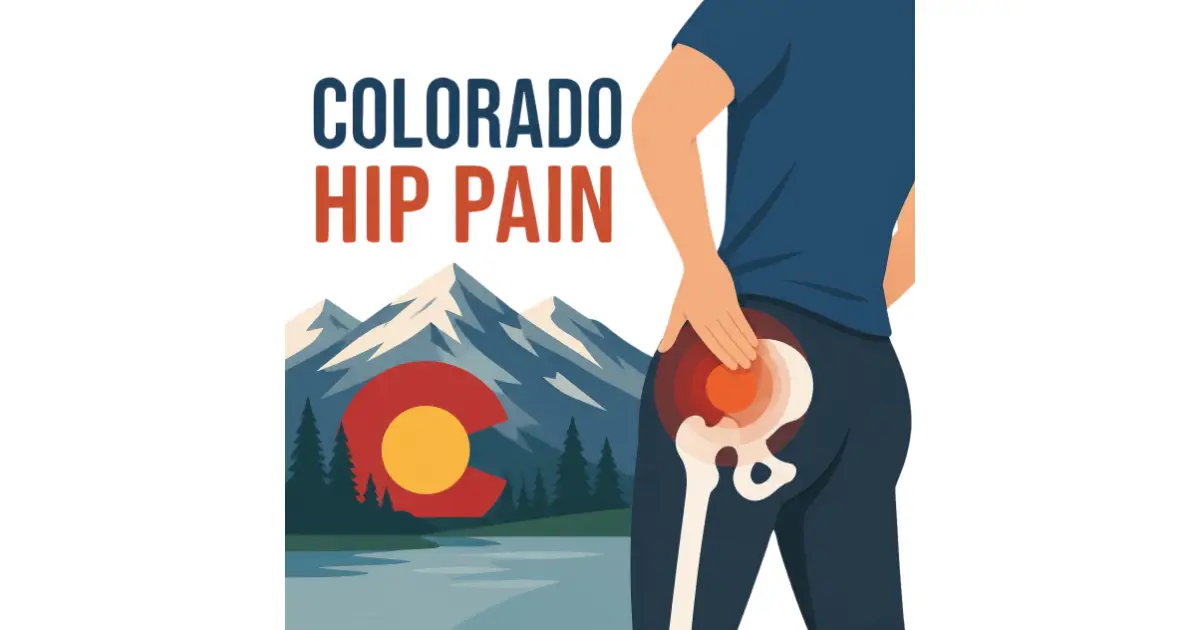
Why does my hip hurt, and what can I do about it?
An X-ray may show arthritis. An MRI may show a labral tear. You may be told you have femoroacetabular impingement, bursitis, tendinopathy or another structural finding. Those findings matter. But they don't always tell the entire story.I created Colorado Hip Pain to help people better understand that story—what their diagnosis means, what it doesn't necessarily mean, what other factors may be contributing to their symptoms, and what options they have for moving forward.

Why I Created Colorado Hip Pain
I'm TJ Pierce, and I've spent more than 20 years working in exercise, movement and manual therapy.Throughout that time, I've worked with people who have very similar diagnoses but very different experiences. One person with significant hip arthritis may still walk, hike and strength train with relatively little difficulty. Another person may struggle with stairs or getting out of a chair. One person may have a labral tear identified on an MRI and significant groin pain. Another may have a similar imaging finding but very different symptoms. That raises an important question: If the diagnosis were the entire explanation, why can two people with the same diagnosis function so differently? That question is at the heart of Colorado Hip Pain. This website was created to help people understand their diagnosis without reducing their entire problem to that diagnosis.
A Diagnosis Is Important. It Isn't Always the Whole Story.
Modern imaging gives us an extraordinary ability to see inside the human body. An X-ray can show changes associated with hip osteoarthritis. An MRI can identify labral and tendon abnormalities. Imaging can show differences in the shape of the femur and acetabulum associated with femoroacetabular impingement. That information can be extremely valuable. But an image can't show me how you walk. It doesn't tell me how much strength you have available around your hip, how your pelvis and spine move, what happens when you squat, whether your symptoms change after sitting or how much physical activity your hip currently tolerates.That's why I prefer to think of imaging as one piece of the puzzle rather than the entire puzzle. Sometimes the structural finding is highly relevant. Sometimes several factors are contributing simultaneously. And sometimes a finding on an image may be less closely related to someone's symptoms than they initially assumed. The goal isn't to dismiss the diagnosis. It's to understand it in context.
Meet TJ Pierce
My professional background sits at the intersection of exercise science, movement and manual therapy. I earned my Bachelor of Science in Exercise Science from the University of Nebraska at Kearney and am a Licensed Massage Therapist in Colorado.Over more than two decades, I've continued my education extensively in movement assessment, strength and conditioning, biomechanics, manual therapy and exercise-based approaches to musculoskeletal problems. My education includes CHEK Practitioner training through Level 3 as well as extensive study of ELDOA, SomaTraining and SomaTherapy methods developed by French osteopath Dr. Guy VOYER.That combination has heavily influenced the way I look at the body.Instead of starting with: "Which exercise treats this diagnosis?" I am more interested in asking: "What does this individual need to move and function better?" Those can be very different questions.
More Than 20 Years Studying Movement and Pain
Experience doesn't replace scientific evidence. But working with people over many years does teach you to appreciate how much individual variation exists. I've repeatedly seen people with similar diagnoses have very different levels of mobility, strength, pain and physical capacity. I've also seen how quickly someone can become defined by an imaging report. They stop squatting because they have a labral tear. They stop hiking because an X-ray shows arthritis.They become afraid of hip flexion because they've been diagnosed with FAI.Sometimes activity modification is absolutely appropriate. But a diagnosis shouldn't automatically become a permanent list of things someone believes they can no longer do. The better question is often: What can you tolerate now, and what capacity can we progressively rebuild?
How I Look at Hip Pain
The hip doesn't function independently from the rest of the body. Every time you walk, run, climb stairs, squat or get out of a chair, the hip is interacting with your pelvis, spine, knee, foot and the muscles and connective tissues surrounding those regions. That's why hip pain sometimes requires looking beyond the exact location where it hurts. Groin pain may involve the hip joint. Pain on the outside of the hip may involve the gluteal tendons or structures around the greater trochanter. Pain around the buttock may have contributions from the hip, surrounding muscles, sacroiliac region or lumbar spine. The goal is not to make hip pain unnecessarily complicated. It's actually the opposite. Determine which factors appear relevant, determine which ones can be changed, and focus your effort there.That may involve improving strength. It may involve mobility. It may involve changing how an activity is performed or temporarily modifying how much load a tissue is experiencing. Sometimes it means recognizing that additional medical evaluation is appropriate.
Education Before Treatment
One of the main reasons I created Colorado Hip Pain is that I believe people make better healthcare decisions when they understand what is happening. If you've been told you have hip osteoarthritis, you should understand what that diagnosis means and how strongly the imaging findings relate to your symptoms.If an MRI identifies a hip labral tear, you should understand that finding before assuming surgery is your only option.If you've been diagnosed with femoroacetabular impingement, you should understand the difference between the structure of your hip and the symptoms you're experiencing. And if your pain is on the outside of your hip, understanding the structures commonly associated with lateral hip pain and hip bursitis can help you ask better questions about your treatment.That's what the Colorado Hip Pain educational library is designed to do.The objective isn't to diagnose you through a website. It's to help you become better informed about your hip so you can have better conversations with the healthcare professionals involved in your care.
When Conservative Care Makes Sense—and When It Doesn't
I have a strong interest in conservative approaches to musculoskeletal pain. Exercise, progressive strength development, movement, appropriate mobility work, education and manual therapy can all have a role depending on the individual and the condition. But conservative care isn't automatically the right answer for everyone. Sometimes an orthopedic consultation is appropriate. Sometimes additional imaging is warranted. Injections can have a role in certain situations. And sometimes surgery or joint replacement ultimately provides the best path forward. The objective shouldn't be to avoid surgery at all costs.It should be to understand your options well enough to make a thoughtful decision about what comes next.If conservative treatment can help you return to the activities you value, that's an excellent outcome. If you've exhausted reasonable conservative options and surgery is appropriate, understanding why you're making that decision is equally valuable.
Colorado Hip Pain + Pierce Family Wellness
Colorado Hip Pain grew out of the work I do every day at Pierce Family Wellness in Centennial, Colorado. After more than 20 years working with people dealing with pain, movement limitations and orthopedic conditions, I wanted to create a resource focused specifically on one of the areas I see frequently: the hip. Colorado Hip Pain brings that experience into one place—combining education about hip conditions with a broader understanding of movement, strength, mobility and the many factors that can influence how a hip feels and functions. For people in Colorado who want to go beyond the educational information on this site, I also work directly with clients at Pierce Family Wellness. There, we can take the principles discussed throughout Colorado Hip Pain and apply them to the individual—looking at how you move, where you're limited, what you're trying to get back to, and what factors may actually be worth addressing.
Who Colorado Hip Pain Is For
Colorado Hip Pain is for people who want to remain active but are being limited by their hip. You may have been diagnosed with osteoarthritis, FAI, a labral tear, bursitis or another hip condition. Or perhaps you don't have a diagnosis at all. You simply know that your hip hurts when you walk, sit, sleep, squat, run, hike, train or climb stairs—and you want to understand why. The site is especially designed for people who aren't satisfied with simply being told to stop doing the activities they enjoy. That doesn't mean ignoring pain or pushing through everything. It means understanding the problem well enough to determine what activities are appropriate now and what you may be able to progressively return to over time.
Start by Understanding Your Hip
If you're trying to understand your hip pain, start with the educational resources here at Colorado Hip Pain. Learn about the condition you've been diagnosed with. Understand what your imaging may—and may not—tell you. Learn how symptoms from the hip can overlap with those coming from surrounding structures. Then use that information to make better decisions about what comes next. Want to learn? Explore the Colorado Hip Pain Articles & Insights. Looking for individualized help in Colorado? Learn more about working with TJ Pierce at Pierce Family Wellness in Centennial.