Hip bursitis is one of the most common diagnoses given to people with pain on the outside of the hip. If it hurts to lie on your side, walk uphill, climb stairs, stand on one leg, or get up after sitting, you may have been told that an inflamed bursa is the problem.
That may be true, but it may not be the entire story.
The bursa is often the structure that becomes irritated. The more important question is why so much pressure, friction, or tension is being placed on that area in the first place.
If treatment only focuses on calming the inflammation without changing the forces that created it, the pain may improve temporarily and then return as soon as normal activity resumes.
What Is Hip Bursitis?
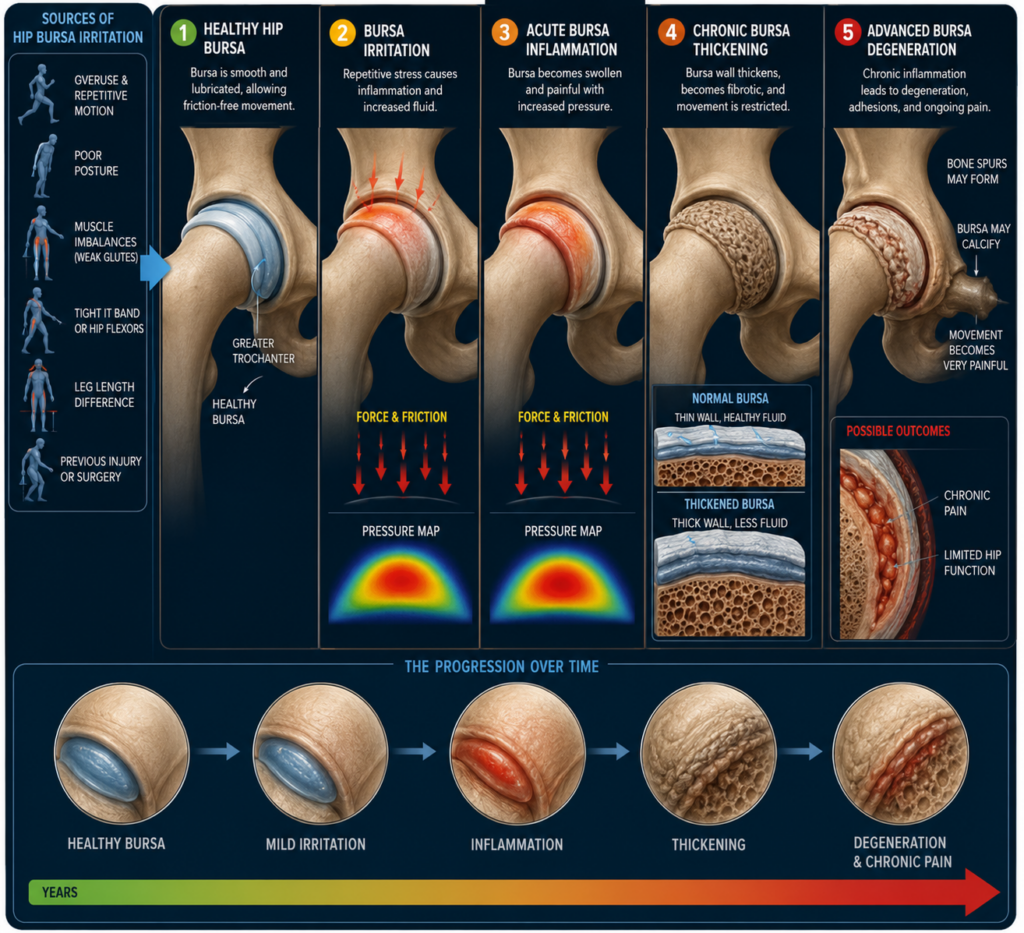
A bursa is a small, fluid-filled sac that helps reduce friction between tissues. Around the outside of the hip, the greater trochanteric bursa provides cushioning where muscles and tendons pass over the prominent portion of the upper femur known as the greater trochanter.
When this area becomes irritated, people commonly feel pain directly over the outside of the hip. The discomfort may travel down the outer thigh, but it usually does not extend below the knee.
The pain is often worse when lying on the affected side because the tissues are being compressed between the body and the bed. Walking, climbing stairs, running, or standing with most of your weight on one leg can also increase symptoms.
However, what is commonly called hip bursitis is not always isolated inflammation of the bursa.
The surrounding gluteal tendons may also be irritated, overloaded, or poorly coordinated. This is why many clinicians now use the broader term greater trochanteric pain syndrome to describe pain in this region. FAI, labral tears, and osteoarthritis may also fall under this category.
Think of the Bursa Like a Cushion Under a Heavy Table Leg
Imagine placing a small cushion beneath one leg of a heavy table.
If the table is level and its weight is distributed evenly, the cushion can do its job without much trouble. But if the table becomes tilted and most of its weight shifts onto that one leg, the cushion begins to flatten and wear down.
Replacing or padding the cushion may help temporarily.
But unless the table is leveled, the same pressure keeps returning.
The bursa works in a similar way. It is designed to reduce friction and provide cushioning, but it cannot continually absorb excessive compression without becoming irritated.
The inflammation may be real, but the uneven force distribution may be the deeper problem.
The Outside of the Hip Is a Busy Intersection
The greater trochanter is not simply a bump on the side of the femur. It is an important attachment point for several muscles and tendons that control the pelvis and hip.
The gluteus medius and gluteus minimus help stabilize the pelvis while you walk. If they are weak, inhibited, painful, or poorly coordinated, the pelvis may drop or shift excessively with every step.
That changes the direction of force passing through the outside of the hip.
The iliotibial band and other fascial structures also travel across this region. If the pelvis, femur, or surrounding fascia is not moving efficiently, these tissues may place additional compression over the bursa and gluteal tendons.
Over time, the outer hip can become the place where multiple mechanical problems finally show themselves.
Why the Hip Should Not Be Treated in Isolation
One of the principles that has shaped my treatment philosophy through SomaTraining and SomaTherapy is that the body functions as an integrated system.
The position of the foot affects the rotation of the lower leg. The lower leg affects the knee. The knee influences the femur, and the femur changes how force enters the hip and pelvis.
The pelvis then interacts with the spine, rib cage, diaphragm, and the fascial structures that connect the trunk to the lower extremities.
A restriction or loss of control in any part of that system may increase the demand placed on the outside of the hip.
For example, limited ankle mobility may cause the leg to rotate differently while walking. Poor pelvic stability may force the gluteal muscles to work harder with every step. Spinal stiffness may shift the body’s center of gravity toward one side. Even standing habitually with your weight pushed into one hip can repeatedly compress the irritated tissues.
None of these factors automatically causes bursitis. However, they can help explain why the inflammation developed and why it sometimes refuses to go away.
Why Rest and Injections May Not Be Enough
Traditional treatment for hip bursitis often begins with rest, ice, anti-inflammatory medication, stretching, or a corticosteroid injection.
These options can be useful, especially when pain is severe and the area needs time to calm down.
The limitation is that reducing inflammation does not necessarily change the way the hip is being loaded.
If someone receives an injection and then returns to the same walking pattern, pelvic instability, posture, or training habits that irritated the area, symptoms may eventually return.
The injection may have treated the fire.
It did not necessarily identify what kept striking the match.
Stretching the Outside of the Hip Can Sometimes Make It Worse
Many people with lateral hip pain are told to stretch the iliotibial band or pull the painful leg across the body.
That may feel helpful for some people, but it can also increase compression over the greater trochanter.
When the leg crosses the midline, the gluteal tendons and surrounding tissues may be pushed more firmly against the bone. If those tissues are already irritated, aggressive stretching can add stress rather than relieve it.
This does not mean stretching is always wrong. It means the exercise needs to match the actual problem.
Sometimes the tissues need improved mobility. Other times they need reduced compression, better coordination, or a gradual increase in load tolerance.
How We Approach Hip Bursitis
At Colorado Hip Pain, we begin by evaluating why the outside of the hip is under stress.
We look at how you stand, walk, balance, squat, and transfer weight from one leg to the other. We assess the feet, ankles, knees, pelvis, spine, and overall gravity line rather than looking only at the painful spot.
Treatment may include manual therapy to improve mobility around the pelvis and hip, myofascial stretching to restore more balanced tension through the lower extremity, and osteo-articular pumping techniques to improve joint mechanics and fluid movement.
Segmental strengthening may also be used to retrain the gluteal muscles and other stabilizers. The goal is not simply to make them stronger. It is to help them contract at the right time, in the right position, and with the appropriate amount of tension.
ELDOA exercises may be incorporated to improve spinal and pelvic organization so the entire body can distribute force more efficiently.
Rather than attacking the inflamed tissue, we work to improve the environment surrounding it.
Exercise Can Help, but Load Must Be Managed
Exercise is usually an important part of recovering from hip bursitis or greater trochanteric pain syndrome.
However, irritated tendons and bursae often respond poorly to sudden increases in activity. Long walks, steep hills, repetitive stairs, side-lying leg lifts, or aggressive stretching may worsen symptoms if introduced too quickly.
The goal is to find a level of movement that stimulates adaptation without repeatedly flaring the area.
That may begin with controlled isometric exercises, improved pelvic positioning, and gradual strengthening before returning to more demanding activities.
Pain does not always mean damage is occurring, but continually provoking the same pain is rarely a productive strategy.
A successful program should gradually make the hip more capable, not simply make it work harder.
Does Hip Bursitis Require Surgery?
Surgery is rarely the first treatment for hip bursitis.
Most people improve through activity modification, progressive exercise, manual therapy, and correction of the movement patterns contributing to the problem.
In cases where pain continues despite appropriate conservative treatment, additional imaging or medical evaluation may be necessary to determine whether there is significant gluteal tendon damage or another condition contributing to the symptoms.
The goal is not to avoid medical procedures when they are needed.
The goal is to make sure the diagnosis explains the entire problem before deciding on the treatment.
The Bottom Line
Hip bursitis describes an irritated structure on the outside of the hip.
It does not always explain why that structure became irritated.
At Colorado Hip Pain, we look beyond the painful bursa and evaluate how your entire body manages force. By improving the function of the feet, legs, pelvis, spine, fascia, and stabilizing muscles, we can often reduce the repeated compression placed on the outside of the hip.
The bursa may be where you feel the pain.
But the cause may involve much more than the bursa itself.
