
When someone tells me their hip hurts, one of my first questions is simple: Where?
Point to it. Is the pain deep in the groin? Is it on the outside of the hip? Or does it feel like it is coming from the buttock or back of the hip?
That distinction matters because “hip pain” isn’t really one thing. The hip sits at the intersection of the pelvis, lumbar spine, and lower extremity. Muscles, tendons, fascia, nerves, ligaments, and joints all occupy a relatively small area, and several of them can produce symptoms that we interpret as hip pain.
This is why the location of your pain can give us valuable clues about what may be happening, but it doesn’t necessarily tell us exactly which structure is responsible.
The Three Main Areas of Hip Pain
Clinically, hip pain is often described according to three general regions: anterior hip or groin pain, lateral or outside hip pain, and posterior hip or buttock pain.
This is a useful starting point when evaluating hip pain. Anterior pain is more commonly associated with structures in or around the hip joint itself. Lateral pain frequently involves tissues surrounding the greater trochanter on the outside of the femur. Posterior pain increases the possibility that structures outside the hip joint, including the lumbar spine, may be contributing.
There is considerable overlap, however. A painful location gives us information, but a painful location is a clue, not a diagnosis.
Groin Pain: Is the Problem Inside the Hip Joint?
When someone points to the front of the hip or deep into the groin, I generally pay closer attention to the hip joint itself.
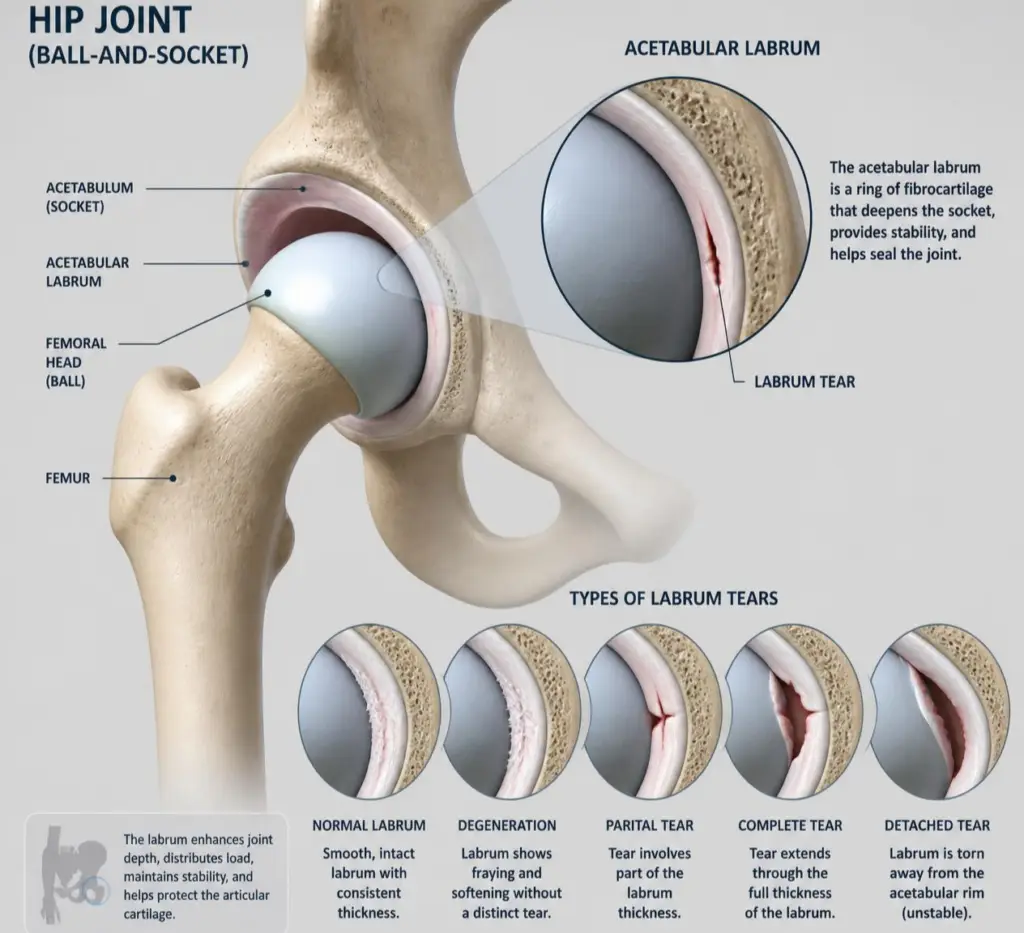
The hip is a ball-and-socket joint. The head of the femur sits inside the acetabulum of the pelvis. Surrounding that articulation are the labrum, joint capsule, ligaments, muscles, tendons, fascia, nerves, and other connective tissues. Problems involving these structures frequently produce anterior hip or groin symptoms.
Common conditions associated with groin pain include hip osteoarthritis, femoroacetabular impingement (FAI), labral pathology, and hip flexor-related problems. In younger adults, FAI and labral problems are common considerations when evaluating intra-articular hip pain, while osteoarthritis becomes increasingly important as we age.
But this is where things become more interesting. Finding arthritis, an impingement, or a labral tear doesn’t automatically prove that you’ve found the cause of someone’s pain. Imaging tells us what the hip looks like. It doesn’t always tell us why the hip hurts.
That’s why I don’t like evaluating hip pain by looking at an MRI in isolation. We also need to understand how the joint moves, what positions reproduce symptoms, how forces are being transferred through the area, and what is happening throughout the rest of the movement system.
The Hip Capsule Matters Too
One structure that receives far less attention than I think it deserves is the hip joint capsule.
The capsule surrounds the hip joint and contributes to both mobility and stability. Different portions of the capsule become tensioned depending on the position of the femur, which means the capsule isn’t simply a passive covering around the joint. It is part of the mechanical system controlling the relationship between the femoral head and acetabulum.
Think of the hip as more than a ball simply spinning inside a socket. There are subtle combinations of rotation, translation, muscular contraction, fascial tension, and capsular tension occurring every time you walk, squat, climb stairs, or get out of a chair.
So when someone has groin pain, I don’t want to know only whether an MRI identified something abnormal. I want to understand how that hip is functioning.
Pain on the Outside of the Hip
Now move your hand from the groin to the bony prominence on the outside of your hip. That’s approximately where you’ll find the greater trochanter of the femur.
Lateral hip pain is commonly grouped under the term greater trochanteric pain syndrome, or GTPS. This can involve structures such as the gluteus medius and minimus tendons, bursae, and surrounding connective tissues.
This is also where terminology can become misleading. For years, a lot of lateral hip pain was simply called hip bursitis. But pain around a bursa doesn’t necessarily mean that inflammation of the bursa is the entire problem. The gluteal tendons and the mechanical environment surrounding the greater trochanter can also be involved.
This distinction matters because simply treating the painful spot doesn’t necessarily address why those tissues became irritated in the first place.
Why Does the Side of My Hip Hurt When I Sleep?
One of the classic complaints with lateral hip pain is, “It hurts when I sleep on that side.”
That makes mechanical sense because lying directly on the affected side places compression through the tissues surrounding the greater trochanter. But sleeping on the opposite side can sometimes bother it too, particularly when the top leg falls inward across the body. That position places the hip into adduction and can alter compression and tension around the lateral hip.
This is a good example of why I pay attention to positions rather than simply asking whether something hurts. When it hurts and what position creates the pain can sometimes tell us more than the presence of pain itself.
Buttock Pain: Is It Really Coming From the Hip?
Posterior hip pain is where the picture gets even more complicated. When someone points to the buttock and calls it hip pain, we have to consider structures both inside and outside the hip.
Possible contributors include the deep gluteal region, proximal hamstrings, sacroiliac region, muscles and connective tissues surrounding the posterior hip, and the hip joint itself. But there is another major possibility that should not be overlooked: the lumbar spine.
Nerves leaving the lumbar spine travel through the pelvis and into the lower extremity. Problems involving the lumbar spine can therefore produce symptoms that are experienced around the hip or buttock. Pain can also be referred from spinal structures without necessarily following the classic pattern people associate with a “pinched nerve.”
This is one reason treating only the place that hurts can sometimes fail. The painful area and the structure contributing to that pain aren’t always the same thing.
Your Hip and Lower Back Are Not Separate Systems
One of the biggest mistakes we can make with hip pain is treating the hip as though it exists by itself.
It doesn’t. The pelvis connects the spine to the lower extremities. The position and movement of the pelvis influence the hip, the lumbar spine influences the pelvis, and the hip influences both.
Then we can go farther down the chain. The femur interacts with the knee, the knee interacts with the foot and ankle, and the foot interacts with the ground. Every step you take requires these regions to manage force together.
That doesn’t mean every person with hip pain has a problem somewhere else in the body, and I think it’s important not to take the “everything is connected” idea too far. It simply means we shouldn’t assume that the painful location is the only place worth evaluating.
What If My Hip Pain Moves Around?
This is another complaint I hear frequently. Someone might feel pain in the groin one day, on the outside of the hip another day, and occasionally into the buttock. Understandably, people can interpret this as evidence that something is getting worse or that multiple structures must be damaged.
That isn’t necessarily the case.
Pain is ultimately an experience produced by the nervous system in response to a combination of sensory information, tissue state, mechanical loading, previous experiences, and other factors. Musculoskeletal symptoms therefore don’t always respect neat anatomical borders. Different activities and positions can also load different tissues at different times.
Even conditions commonly associated with one location don’t have to stay there. FAI, for example, frequently produces anterior or groin symptoms, but symptomatic patients can also report lateral, posterior, or more broadly distributed pain.
This is another reason I don’t recommend diagnosing your hip based on a pain-location chart alone.
Location Is the Beginning of the Assessment, Not the End
If you came into my office and told me that your hip hurt, knowing whether you pointed to the groin, outside of the hip, or buttock would be valuable information. But that would only be the beginning of the assessment.
I would also want to know what movements hurt, whether sitting bothers it, what happens when you walk or climb stairs, whether you can sleep on that side, whether symptoms travel down your leg, whether your back is involved, and whether the problem began suddenly or developed gradually over time.
Then I want to see you move. How does the hip rotate? How does the pelvis move? What happens during a squat? What happens when you stand on one leg or walk? Most importantly, can we identify movements or positions that consistently reproduce or reduce the symptoms?
The goal isn’t simply to find something abnormal. The goal is to understand the relationship between your symptoms, anatomy, and movement.
Don’t Chase the Pain—Find the Source
If there is one idea I want you to take away from this article, it’s that where you hurt matters, but where you hurt isn’t necessarily where the problem begins.
Groin pain may point us toward structures within the hip joint. Lateral pain may direct our attention toward the gluteal tendons, bursa, and tissues surrounding the greater trochanter. Buttock pain may make us investigate the posterior hip, pelvis, and lumbar spine more carefully. None of those locations, however, provides a diagnosis by itself.
A good hip assessment therefore asks a much bigger question: Why is this area being stressed in the first place?
That shift—from simply naming the painful structure to understanding how the entire system is functioning—is often where we begin to make sense of persistent hip pain.
If your hip has been hurting and you’re not sure whether the problem is coming from the hip itself, the surrounding tissues, or somewhere else in the movement system, a comprehensive assessment can help determine the next step.
TJ Pierce
