When someone comes to see me to understand hip pain biomechanics, they usually expect me to spend most of our time looking at their hip. And while the hip is certainly important, it is only one part of a much larger movement system.
Think about what happens when you take a step. Your foot contacts the ground, your ankle moves, your knee bends, your femur rotates, your pelvis shifts, and your spine makes subtle adjustments to keep you balanced. All of this happens without you consciously thinking about it.
Now imagine that one of those areas isn’t moving particularly well. Maybe your ankle has lost some mobility, your hip doesn’t rotate as freely as it used to, or your pelvis has difficulty controlling movement when you’re standing on one leg. The rest of your body still has to figure out how to get you from point A to point B.
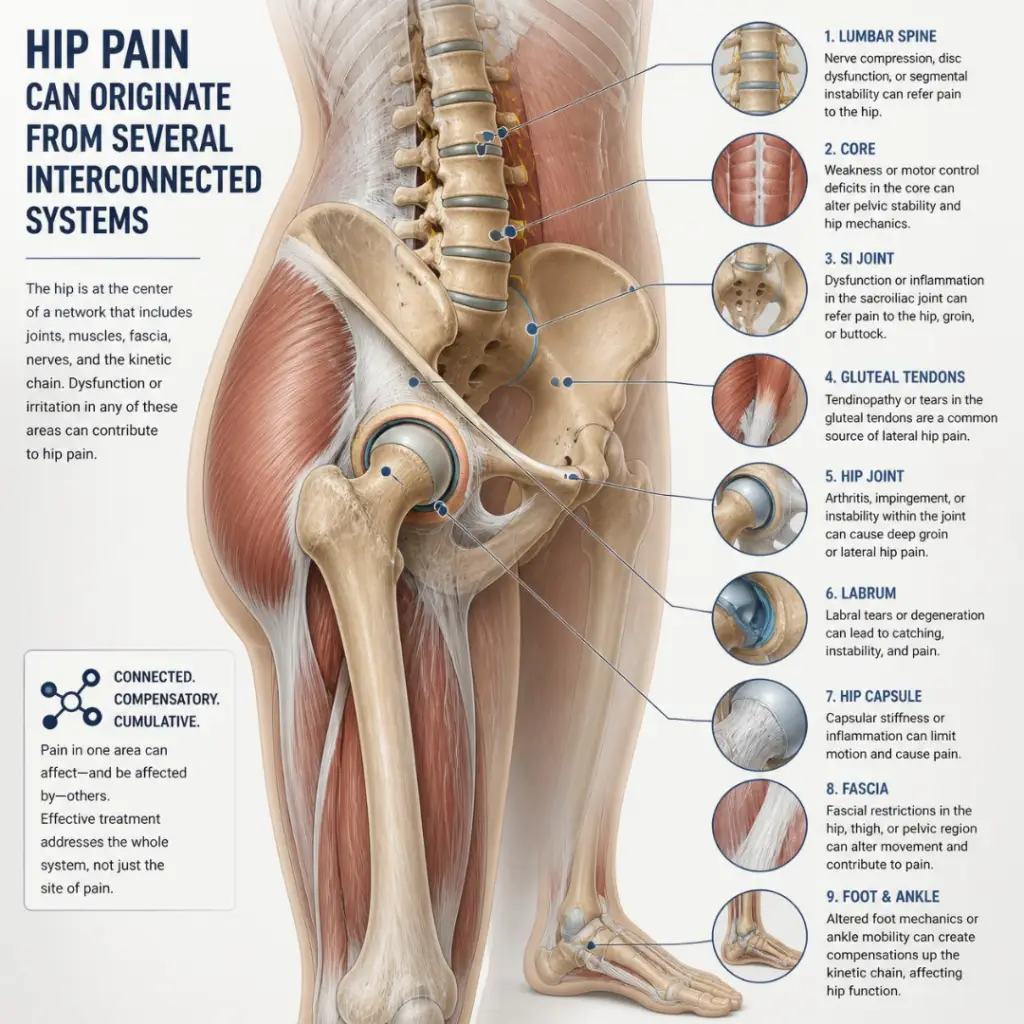
This is one reason I don’t like looking at hip pain as an isolated problem. The hip is part of a system, and understanding how that system functions can sometimes explain why symptoms persist even after you’ve spent months working on the painful area.
Understanding the Relationship Between Hip Pain Biomechanics and Pelvis
Let’s start with the pelvis because it is the foundation of the hip joint.
The pelvis is made up of the sacrum and two hip bones, each formed by the fusion of the ilium, ischium, and pubis. On either side of the pelvis is the acetabulum, which forms the socket of the hip joint. The head of the femur sits inside that socket, creating the ball-and-socket articulation we commonly call the hip.
What makes this relationship interesting is that the socket isn’t stationary. Every time your pelvis tilts forward, tilts backward, or rotates, the orientation of the acetabulum changes relative to the femur and the rest of your body.
For example, when you squat, the femur moves relative to the pelvis, but the pelvis also moves relative to the lumbar spine. Both movements contribute to your ability to lower yourself toward the ground.
If you have limited hip flexion, you may compensate by moving more through the pelvis and lumbar spine. Conversely, if your pelvis and lumbar spine aren’t moving appropriately, the hip may experience different mechanical demands during the same movement.
This doesn’t automatically mean that compensation is harmful. The human body is designed to adapt, and movement variability is normal. The question is whether a particular movement strategy is contributing to symptoms or limiting someone’s ability to perform the activities they enjoy.
The Hip Joint Needs Both Mobility and Stability
One of the most important concepts I teach my clients is that the hip needs to be mobile without sacrificing stability.
The hip is designed to move in multiple directions, including flexion, extension, abduction, adduction, and internal and external rotation. But having access to those movements is only part of the equation. The muscles, joint capsule, ligaments, and nervous system also need to coordinate those movements under load.
Consider walking. When your right foot is on the ground and your left leg swings forward, your right hip has to support your body while your pelvis remains sufficiently controlled. The gluteus medius and other muscles around the hip contribute to managing the position of the pelvis during this single-leg support phase.
If those muscles aren’t producing or coordinating force effectively, the pelvis may move differently. But the solution isn’t always as simple as strengthening the gluteus medius. We also have to consider hip joint mobility, available movement strategies, balance, strength, and the demands of the activity itself.
This is why I evaluate both mobility and motor control. Someone can have plenty of flexibility but struggle to control a movement, while another person may have good strength but lack the joint motion needed to perform an activity comfortably.
How the Lumbar Spine Influences Hip Mechanics
The relationship between the hip and lumbar spine is particularly important because they share movement responsibilities through the pelvis.
When you bend forward to pick something up, some movement comes from your hip joints and some comes from your lumbar spine. The amount contributed by each region varies depending on the task, your anatomy, your mobility, and how you’ve learned to move.
Now imagine someone who has significantly limited hip flexion. To reach the same position, that person may need to change how much they move through the pelvis or spine. In certain circumstances, this can alter the mechanical demands on the lumbar region.
The relationship works in the opposite direction as well. Changes in spinal mobility or pelvic positioning can influence the movement available at the hip.
Researchers have described this interaction as part of hip-spine syndrome, recognizing that hip and lumbar spine conditions can coexist and influence one another.
A clinical review published in PM&R discusses how hip motion, lumbopelvic mechanics, and overlapping pain patterns complicate the assessment of people with hip and lower-back symptoms. You can read the research here: Links Between the Hip and the Lumbar Spine.
This relationship also explains why someone can experience pain around the hip even when the primary contributor is in the lumbar spine. We explored that distinction in our previous Colorado Hip Pain article on hip pain and its relationship to the back.
What About the Sacrum and Sacroiliac Joints?
The sacrum sits between the two hip bones and forms the lower portion of the spine. On either side are the sacroiliac joints, which help transfer forces between the trunk and lower extremities.
Unlike the hip, which has substantial movement in several directions, the sacroiliac joints have relatively small amounts of motion. Their primary role involves stability and load transfer rather than large movements.
When you’re walking, standing on one leg, or carrying something heavy, forces travel through the pelvis and sacroiliac region. Muscles and connective tissues surrounding the pelvis contribute to managing those forces.
This is one reason I pay attention to how someone transfers weight from one leg to the other. It can provide useful information about their balance, strength, movement coordination, and tolerance for loading.
However, observing an uneven pelvis or an asymmetrical movement pattern does not establish that a sacroiliac joint is dysfunctional. Those findings need to be interpreted alongside symptoms, physical examination, and the person’s overall movement capabilities.
Your Foot Can Influence What Happens at Your Hip
Now let’s move farther down the body.
Your foot is your primary point of contact with the ground when you’re standing and walking. It has to provide enough mobility to adapt to the surface beneath you while also developing sufficient stiffness to help propel you forward.
During walking, movement occurs throughout the foot and ankle. The subtalar joint contributes to pronation and supination, the tibia rotates, and the knee and hip coordinate movement above it.
Because these joints are mechanically linked, changes in foot and ankle movement can influence how the lower extremity moves.
For example, when the foot pronates during walking, it commonly occurs alongside internal rotation of the tibia. Depending on the person’s movement strategy, changes in tibial rotation can also influence the movement occurring at the knee and hip.
But there is an important distinction between saying that the foot influences lower-extremity mechanics and claiming that a particular foot position causes hip pain.
Research has not established that everyone with flat feet, excessive pronation, or a particular arch shape will develop hip problems. A systematic review published in Gait & Posture found some associations between foot posture and lower-extremity movement, but the findings were inconsistent and generally involved small effects.
You can review that research here: The Relationship Between Foot Posture and Lower Limb Kinematics During Walking.
For me, the practical takeaway is that the foot deserves consideration during a hip assessment, particularly when someone’s symptoms occur during walking or other weight-bearing activities. But I wouldn’t assume that changing someone’s foot position will automatically resolve their hip pain.
Why Walking Can Reveal Problems That Stretching Doesn’t
Walking is one of the most useful activities to observe because it requires the body to coordinate movement while repeatedly transferring weight from one leg to the other.
Think about what happens as your leg moves behind you during the later portion of the stance phase. Your hip needs to move into extension while the pelvis and lumbar spine coordinate with that movement.
If hip extension is limited, you may change your stride length, pelvic movement, or trunk position. Those adjustments might allow you to keep walking comfortably, or they might be associated with symptoms during longer walks.
Now consider what happens when your foot contacts the ground. Your lower extremity needs to manage the forces associated with accepting your body weight. Your hip muscles contribute to controlling the femur and pelvis while the foot and ankle adapt to the ground.
This is a much more complicated process than simply asking whether your hip flexors are tight or your glutes are weak.
It’s also why someone may feel perfectly comfortable stretching on the floor but experience hip pain after walking for 20 minutes. The demands of walking involve repeated loading, balance, endurance, and coordination that aren’t reproduced by a passive stretch.
If you’re experiencing pain in the front, outside, or back of your hip, our article on where hip pain is felt provides additional context about the different structures that may contribute to those symptoms.
The Role of the Hip Capsule and Surrounding Fascia
Two areas I pay particular attention to are the hip joint capsule and the connective tissues surrounding the pelvis and femur.
The hip capsule is a strong connective tissue structure that surrounds the joint. It contributes to stability while also influencing the movement available between the femoral head and acetabulum.
Different portions of the capsule become tensioned depending on the position of the hip. For example, the capsular ligaments generally become more tensioned as the hip moves toward extension, contributing to passive stability when we’re standing.
The surrounding fascia also plays a role in transmitting and distributing forces generated by muscles. Structures such as the fascia lata, iliotibial tract, and connective tissues associated with the gluteal muscles form part of the mechanical environment surrounding the hip.
In my work, this is where techniques such as myofascial stretching, osteo-articular joint pumping, and specific strengthening exercises become relevant.
The objective isn’t simply to stretch every tight structure. It’s to assess where movement is limited, where strength or control may be insufficient, and how the person responds to different interventions.
I also think it’s important to distinguish biomechanical theory from established clinical outcomes. Although connective tissues clearly contribute to joint mechanics, we don’t yet have strong evidence that a particular hands-on technique reliably changes hip capsule position or permanently corrects joint alignment.
What we can evaluate is whether an intervention improves someone’s movement, symptoms, strength, and ability to perform meaningful activities.
Why I Don’t Automatically Try to Correct Everyone’s Posture
Posture is another area where I think the discussion often becomes oversimplified.
It’s common to hear that anterior pelvic tilt, flat feet, or an uneven pelvis is the reason someone has hip pain. But human bodies aren’t perfectly symmetrical, and there isn’t one ideal posture that everyone needs to maintain.
A person can have an anterior pelvic tilt and no pain whatsoever. Another person may have what appears to be excellent standing posture and still experience significant hip symptoms.
That doesn’t mean posture is irrelevant. The position of the pelvis and spine can change joint orientation and the demands placed on surrounding tissues. But posture needs to be evaluated in the context of movement, loading, symptoms, and the person’s individual anatomy.
Instead of trying to make everyone stand in one predetermined position, I’m more interested in whether they can move comfortably between different positions and manage the demands of their daily activities.
How I Approach the Entire Movement System
When someone comes into my office with persistent hip pain, I begin by understanding their symptoms and medical history. Where does the pain occur? What activities aggravate it? What makes it better? Have they had imaging, previous injuries, or medical treatment?
Then I look at how they move.
I want to see how the hip rotates, how the pelvis moves during hip flexion and extension, and how the lumbar spine contributes to those movements. I also look at standing balance, single-leg support, walking, and the mobility of the foot and ankle when those findings are relevant.
From there, I can begin identifying which limitations appear to matter most.
For one person, improving hip strength and load tolerance may be the priority. For another, the initial focus may be restoring comfortable movement or modifying activities that repeatedly aggravate symptoms. Someone else may need further medical evaluation before beginning a movement program.
The important point is that the assessment determines the intervention, rather than assuming everyone with hip pain needs the same exercises.
Looking Beyond the Painful Hip
If you’ve been dealing with hip pain for months or years, it’s understandable to focus on the area that hurts. But the hip doesn’t work independently from the rest of your body.
Your pelvis influences the orientation of the hip socket. Your lumbar spine and hips share movement responsibilities. Your foot and ankle contribute to how you interact with the ground, and your muscles and nervous system coordinate the entire process.
That doesn’t mean the cause of your hip pain is always somewhere else. Sometimes the hip joint itself is the primary problem, as can occur with hip osteoarthritis, femoroacetabular impingement, or labral pathology.
It means we should be willing to look beyond the painful location when the symptoms and examination suggest that other regions may be contributing.
After more than 20 years of working with people who have musculoskeletal problems, one of the principles I keep coming back to is that understanding movement gives us more useful information than simply identifying something that looks abnormal.
The goal isn’t perfect posture, perfectly symmetrical movement, or unlimited flexibility. It’s helping you develop the mobility, strength, coordination, and confidence needed to continue doing the activities that matter to you.
Because ultimately, the goal isn’t just to have a hip that hurts less. It’s to have a body that allows you to stay active and enjoy your life.
If you’re dealing with persistent hip pain and haven’t been able to identify what’s contributing to it, a comprehensive movement assessment can help clarify which factors may be relevant and what steps make sense next.
