Can your back cause your hip pain? If your hip hurts, it seems logical to assume there is something wrong with your hip.
Sometimes there is. But one of the things I have learned after working with people with chronic hip, back, and lower-extremity problems for more than 20 years is that the place where you feel pain isn’t always the place where the problem originates.
The lumbar spine can produce symptoms that are felt in the buttock, around the side of the hip, into the groin, or farther down the leg. At the same time, problems involving the hip can produce symptoms that overlap with what people commonly think of as back or sciatic pain.
This overlap is sometimes described as hip-spine syndrome, and it is one reason evaluating persistent hip pain requires looking beyond the hip itself.
How Can Your Back Cause Pain in Your Hip?
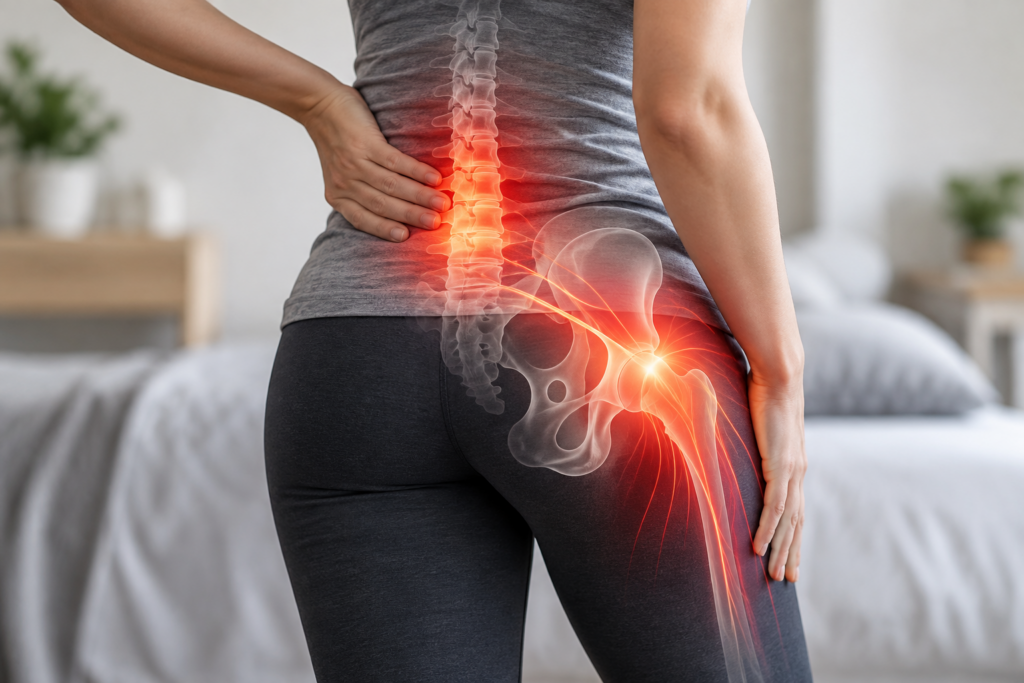
Your lumbar spine is made up of five vertebrae with intervertebral discs between them. Around those vertebrae are facet joints, ligaments, muscles, fascia, and an extensive neurological system. Nerve roots leave the spinal canal and eventually contribute to the nerves that travel through the pelvis and lower extremities.
Because of this anatomy, pain arising from structures in the lumbar region does not necessarily stay in the lower back.
Symptoms originating from the lumbar spine can be perceived in the buttock, hip, groin, or thigh and sometimes extend farther down the leg. Research examining referred pain from the lumbar region has documented considerable overlap between these areas.
This creates a common problem. You feel something around your hip, so naturally you start treating your hip. You stretch it, massage it, strengthen it, or perhaps have imaging performed on it. If the primary contributor is actually somewhere else, however, repeatedly treating the painful area may not change the underlying problem.
Referred Pain Is Not the Same as Sciatica
This distinction is important because people often use the terms referred pain, sciatica, pinched nerve, and radiculopathy interchangeably. They don’t mean the same thing.
Referred pain means that pain is perceived somewhere other than the tissue believed to be generating the painful stimulus. Pain arising from structures in the lumbar region, for example, may be perceived around the buttock or hip without necessarily involving injury or dysfunction of a nerve root.
Radicular pain involves pain associated with irritation or abnormal activity involving a spinal nerve root or its dorsal root ganglion. People often describe this type of pain as shooting, electric, burning, or traveling along the extremity, although symptoms vary considerably.
Radiculopathy is more specific. It refers to neurological dysfunction associated with a nerve root and can involve measurable changes in strength, sensation, or reflexes. A person can therefore have referred pain from the lumbar spine without having radiculopathy, and not every person whose symptoms travel into the leg has a “pinched nerve.”
Understanding those differences matters because the treatment approach should depend on what is actually contributing to the symptoms rather than simply what we call the painful area.
Why the Hip and Back Are So Difficult to Separate
The hip and lumbar spine don’t function as two independent pieces of anatomy.
Your lumbar spine sits above the pelvis, and the pelvis forms the socket of the hip joint. Every time you bend forward, squat, walk, climb stairs, or get out of a chair, movement has to be distributed between the lumbar spine, pelvis, and hip.
If one region isn’t contributing appropriately, another region may have to contribute more.
For example, if hip motion is limited, additional movement may occur through the pelvis and lumbar spine during certain activities. Conversely, changes in spinal or pelvic movement can alter the mechanical demands placed on the hip.
This doesn’t mean that every stiff hip causes back pain or every back problem causes hip pain. Human movement is far more complicated than that. But there is enough interaction between these regions that evaluating one while completely ignoring the other can leave an important part of the picture unexplored. Research on hip-spine syndrome specifically describes this overlap in both symptom distribution and biomechanics.
What Does Back-Related Hip Pain Feel Like?
There isn’t one symptom pattern that reliably tells us, “This is definitely coming from your back.”
Back-related symptoms may be felt in the buttock, lateral hip, groin, thigh, or lower leg. Some people have obvious lower-back pain along with their hip symptoms. Others are surprised when evaluating the lumbar spine changes the symptoms around their hip because their back wasn’t their primary complaint.
That is why I am cautious about pain-location charts that imply a specific location identifies a specific damaged structure. Human pain patterns overlap too much for that.
Instead, I am interested in how symptoms behave. Does moving the lumbar spine reproduce the hip symptoms? Does changing spinal or pelvic position make them better or worse? Do symptoms travel? Are there changes in sensation or strength? Does prolonged sitting affect them? What happens during walking? What happens when we move the hip independently from the lumbar spine?
Those relationships can provide much more useful information than the location of pain alone.
Your MRI May Not Answer the Question
Imaging can be extremely valuable when it is medically indicated, but imaging findings have to be interpreted within the larger clinical picture.
A lumbar MRI may show disc degeneration, bulging discs, facet changes, or other structural findings. A hip X-ray or MRI may show osteoarthritis, a labral tear, cartilage changes, or femoroacetabular morphology.
The difficult question is not simply, “What did the image find?”
The more important question is, “Does that finding explain this person’s symptoms?”
It is possible for someone to have structural findings in both the hip and lumbar spine. In that situation, identifying an abnormality on an image doesn’t automatically establish which region is primarily responsible for the symptoms.
This is one of the central problems in hip-spine syndrome. Sometimes the hip is the primary contributor. Sometimes the lumbar spine is. Sometimes both regions are involved.
That is why imaging should complement a good history and physical assessment rather than replace them.
Sometimes the Hip Can Look Like a Back Problem Too
The confusion works in both directions.
Hip osteoarthritis is commonly associated with groin pain, but symptoms can also be experienced around the buttock, lateral hip, thigh, knee, and even farther down the leg. Other hip conditions can produce similarly overlapping patterns.
That means someone who assumes every symptom traveling into the leg must be coming from the lumbar spine can make the same mistake as someone who assumes every pain around the hip must originate in the hip.
This is why I don’t like beginning an assessment with a conclusion.
I would rather ask: What evidence do we have that the hip is contributing? What evidence do we have that the spine is contributing? And what happens when we change how each region moves?
How I Look at Hip and Back Pain Together
When I work with someone who has persistent hip pain, I don’t evaluate only the spot that hurts. I want to understand how the hip, pelvis, and lumbar spine are functioning together.
I look at hip flexion, extension, and rotation. I want to see how the pelvis moves during those motions and whether the lumbar spine is compensating. I look at standing posture, walking, single-leg support, and other movements relevant to that person’s symptoms.
I also want to know whether changing movement somewhere else changes the painful area.
For example, if someone reports lateral hip or buttock pain but certain lumbar movements consistently reproduce or reduce those symptoms, that is meaningful information. If moving the lumbar spine has little effect but specific hip positions consistently reproduce the symptoms, that points us in another direction.
No single test necessarily gives us the answer. What matters is the pattern that begins to emerge when the history, movement assessment, neurological findings when appropriate, and imaging when necessary are considered together.
Why Treating Only the Painful Spot Can Fail
This is one of the most important lessons in chronic musculoskeletal problems.
If your lateral hip hurts, rubbing or stretching the lateral hip may temporarily feel good. If your buttock hurts, working on the muscles in the buttock may provide temporary relief. There is nothing inherently wrong with symptom relief.
But if the symptoms keep returning, I think we need to ask a different question.
Why does this area keep becoming symptomatic?
Maybe the issue is primarily local to the hip. Maybe lumbar referral is contributing. Maybe the hip has lost motion and the lumbar spine is compensating. Maybe both areas have legitimate problems.
The answer isn’t automatically “everything is connected.” That phrase gets overused and can become meaningless. The better approach is to determine which connections are actually relevant to the individual standing in front of us.
When Hip Pain Needs Medical Evaluation
Most hip and back symptoms are musculoskeletal, but not every symptom around the hip should be approached as a movement problem.
New or progressive leg weakness, significant numbness, changes in bowel or bladder control, numbness around the saddle region, major trauma, fever or systemic illness associated with severe pain, or rapidly worsening unexplained symptoms warrant medical evaluation. Sudden inability to bear weight or severe unexplained hip pain also deserves appropriate medical assessment.
The purpose of a movement assessment isn’t to replace medical diagnosis. It is to help determine how movement and mechanical factors may be contributing once serious pathology has been appropriately considered.
Stop Thinking About the Hip in Isolation
The biggest idea I want you to take away from this is simple: hip pain does not automatically mean the hip is the source of the pain.
The lumbar spine can refer symptoms toward the hip, buttock, groin, and thigh. Nerve-root involvement can produce another set of symptoms that may extend farther down the leg. At the same time, genuine hip pathology can produce symptoms that resemble a spinal problem.
That overlap is precisely why persistent hip pain deserves more than chasing the location that hurts.
When I assess someone with hip symptoms, I want to know what the hip is doing, what the pelvis is doing, what the lumbar spine is doing, and how those regions behave together during the activities that matter to that person.
The goal isn’t to find as many things wrong with someone as possible. It’s to narrow the problem down.
Is the hip driving the symptoms? Is the spine contributing? Are both involved? And, most importantly, what can we actually change?
Answering those questions gives us a much better starting point than simply treating whichever body part happens to hurt today.
