Hip pain can be frustrating because the place where you feel the pain isn’t always where the problem is coming from. You might feel pain deep in the front of your hip and assume something is wrong with the joint. You might feel pain along the outside of your hip and assume you have bursitis. Or you may have been told that arthritis on an X-ray explains everything. Sometimes those explanations are correct, but hip pain is rarely as simple as pointing to one structure and saying, “That’s the problem.”
The hip is influenced by the pelvis, spine, muscles, fascia, nerves, and the way forces travel through your entire lower body. That is why understanding hip pain requires looking at the hip itself while also considering the larger system around it.
Where Is Your Hip Pain?
One of the first things I look at with hip pain is simply where the person feels it. Pain in the front of the hip or groin tends to make me think more about structures associated with the hip joint itself. Pain along the outside of the hip may involve the muscles, tendons, fascia, or bursa around the greater trochanter. Pain toward the back of the hip can sometimes have more involvement from the pelvis, sacroiliac region, or lumbar spine.
But location is only a clue. Think of the warning light on your car. It tells you something needs attention, but it doesn’t necessarily tell you which part needs to be replaced. Pain works in much the same way, which is why I don’t like treating hip pain based solely on where someone points.
Hip Osteoarthritis
Hip osteoarthritis is one of the most common explanations people are given for hip pain, particularly as they get older. Osteoarthritis involves changes within the joint, including cartilage loss and changes to the underlying bone. As it progresses, people may experience stiffness, reduced range of motion, groin pain, or difficulty with activities such as walking, putting on shoes, getting out of a chair, or getting in and out of a car.
But there is an important distinction between having arthritis and having pain. Changes on an X-ray don’t always correlate perfectly with symptoms. Some people have significant arthritic changes with relatively little pain, while others experience substantial pain with less dramatic imaging findings. That is why I view imaging as one piece of the puzzle rather than the entire answer.
If you have hip arthritis, the question shouldn’t only be, “How bad does my X-ray look?” A better question is, “How well is my hip functioning?” Range of motion, strength, movement quality, activity tolerance, and the condition of the tissues surrounding the joint can all influence what you are able to do.
Femoroacetabular Impingement
Femoroacetabular impingement, usually called FAI, describes a situation where the shape of the femur, acetabulum, or both can create contact within the hip during certain movements. People with FAI commonly describe pain in the front of the hip or groin, particularly with deep hip flexion, squatting, sitting for long periods, or athletic movements involving rotation.
But once again, structure doesn’t automatically equal symptoms. Some people have hip shapes consistent with FAI and never develop significant pain. That means the shape of the joint matters, but so does everything surrounding it.
Hip mobility, pelvic position, muscular control, tissue tension, training volume, and how forces are distributed through the body can all influence whether a particular hip becomes irritated. We may not be able to change the shape of someone’s bones, but we can often change many of the factors determining how those bones and surrounding tissues are being loaded.
Hip Labral Tears
The labrum is a ring of fibrocartilage surrounding the socket of the hip. It helps deepen the socket, contributes to stability, and plays an important role in how forces are distributed through the joint. A labral tear can produce groin pain, clicking, catching, stiffness, or discomfort with twisting and rotational movements.
The tricky part is that labral tears can also exist without causing symptoms. An MRI can identify something structurally abnormal without necessarily proving that it is the primary source of a person’s pain. That doesn’t mean the tear should be ignored. It means the finding needs to be considered alongside everything else happening at the hip.
If someone has a labral tear, I want to know how the pelvis moves, how much rotation the hip has, what is happening at the lumbar spine, and how the muscles are controlling the femur. I also want to know which movements actually reproduce the person’s symptoms. Those questions help put the MRI finding into context.
Hip Bursitis and Pain on the Outside of the Hip
Pain on the outside of the hip is often called hip bursitis. There are small fluid-filled sacs called bursae around the hip that help reduce friction between tissues, and these structures can become irritated. However, lateral hip pain is often more complicated than simply having an inflamed bursa.
The gluteal tendons, iliotibial region, surrounding fascia, muscular tension, and mechanics of the pelvis and femur can all contribute to symptoms around the greater trochanter. This is one reason repeatedly treating inflammation may provide temporary relief without necessarily addressing why the area keeps becoming irritated.
If the same tissue keeps getting overloaded, it makes sense to ask why. Sometimes the painful structure is the problem, but sometimes it is the structure that has been compensating for something happening elsewhere.
Your Hip Pain May Not Be Coming From Your Hip
This is one of the most important things to understand about hip pain. Sometimes the hip hurts even though the hip itself isn’t the primary problem. The lumbar spine can refer symptoms toward the hip, and nerves originating from the spine can create pain or altered sensation around the hip and thigh. The sacroiliac region and surrounding tissues can also produce symptoms that people interpret as hip pain.
The opposite can happen as well. A restricted or painful hip can cause someone to change how they move, potentially increasing stress somewhere else in the body. If the hip stops rotating efficiently, for example, the pelvis, knee, or lower back may have to contribute more movement.
The body doesn’t operate as a collection of independent parts. It operates as a connected system, and that becomes particularly important when dealing with pain that has persisted for months or years.
The Pelvis Changes How the Hip Works
The hip joint is created by the head of the femur sitting inside the acetabulum, which is part of your pelvis. That means every time your pelvis changes position, you are also changing the orientation of the hip socket. This is one reason I pay so much attention to the pelvis when evaluating hip pain.
If the pelvis isn’t moving well, the femur may have to compensate. If one side of the pelvis behaves differently than the other, forces through the two hips may also be different. Over thousands of steps, workouts, squats, and everyday movements, those small differences can become significant.
This doesn’t mean there is one “perfect” pelvic position everyone needs to maintain. Human beings are supposed to move. The goal is having enough mobility and control throughout the system that the same tissues aren’t repeatedly asked to absorb more stress than they can tolerate.
Fascia Can Influence Hip Movement
Muscles aren’t isolated ropes pulling on bones. They exist within a continuous network of connective tissue and fascia that helps transmit force throughout the body. Around the hip, this becomes particularly important because so many muscular and fascial structures interact with both the pelvis and femur.
The abdominal wall, pelvic muscles, gluteals, adductors, hamstrings, quadriceps, iliopsoas, and tissues surrounding the lower back all influence this region. If certain tissues become restricted or stop transmitting force efficiently, other areas may have to compensate.
This is why stretching the exact spot that hurts doesn’t always solve hip pain. Sometimes the painful tissue is simply where the compensation is showing up. Looking at the relationships between these tissues can give us a much better understanding of why a particular area continues to become irritated.
Strength Matters, but More Strength Isn’t Always the Answer
When someone has hip pain, they are often told they need to strengthen their glutes. Sometimes they do, and strength is certainly an important part of maintaining healthy hips. But simply making a muscle stronger doesn’t guarantee that the hip will move better.
Timing, coordination, joint position, mobility, proprioception, and the ability to distribute force all matter. You can have very strong muscles and still have poor movement options.
I think of strength as horsepower. More horsepower can be useful, but if the wheels aren’t aligned and the suspension isn’t functioning properly, adding a bigger engine doesn’t necessarily solve the problem. The goal should be to build strength within a system that moves well.
Why Hip Pain Often Requires a Whole-Body Approach
When I evaluate someone with hip pain, I’m interested in much more than the painful spot. I want to understand what the hip can and can’t do, how it rotates, how the pelvis moves, what happens when the person squats or walks, and how well they control the body when standing on one leg. I also want to know what is happening at the spine and whether certain tissues are unusually restricted.
The goal isn’t to make an evaluation unnecessarily complicated. It is actually the opposite. The goal is to identify the few things that matter most for that particular person.
Two people can walk into my office with the exact same diagnosis and need very different approaches. Once you understand what appears to be driving the problem, treatment and exercise can become much more specific.
Don’t Let an Imaging Finding Become Your Identity
One of the biggest problems I see with hip pain is that people begin identifying themselves by their diagnosis. They start thinking of themselves as someone with arthritis, a torn labrum, or hip impingement. Those diagnoses can contain useful information, but they don’t tell you everything about what your body is capable of doing.
Your MRI doesn’t show how well you control your pelvis. Your X-ray doesn’t measure your strength, movement quality, or ability to tolerate load. Imaging also cannot fully show how your nervous system coordinates movement or how the different tissues surrounding the hip are functioning together.
A diagnosis should help guide the next step. It shouldn’t become a sentence that convinces you that movement, exercise, or the activities you enjoy are no longer possible.
So Why Does Your Hip Hurt?
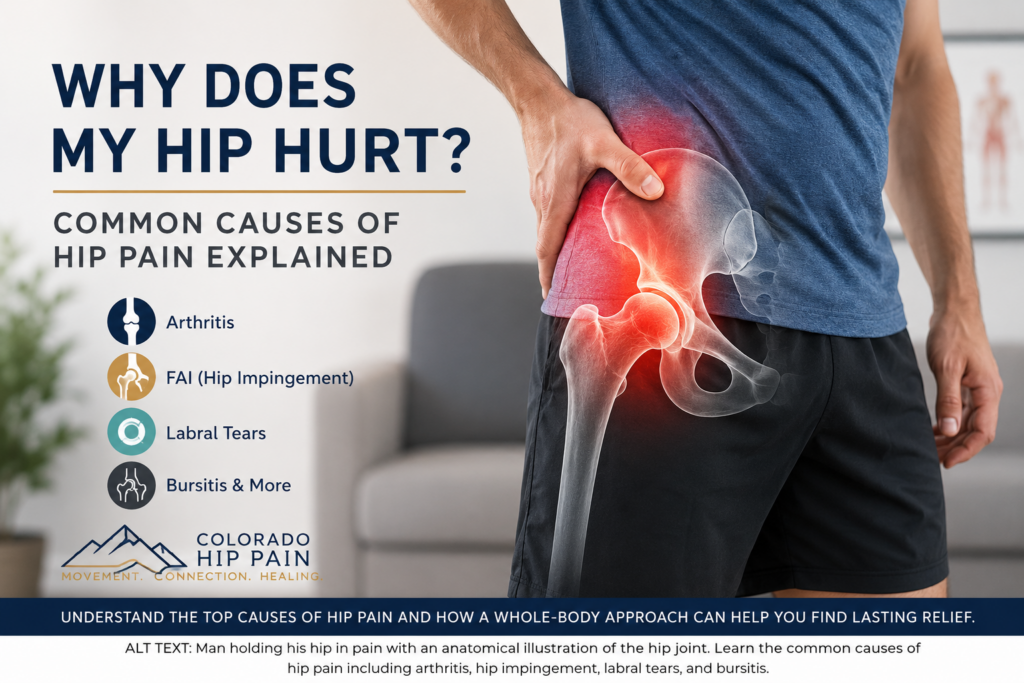
There isn’t one answer that applies to everyone. Your pain could involve osteoarthritis, FAI, a labral tear, lateral hip structures, muscles, tendons, fascia, the pelvis, the spine, nerves, or some combination of these factors. That is precisely why chasing the painful spot isn’t always enough.
The better question is not simply, “What structure hurts?” It is, “Why is this area being irritated, and what can we change to help it function better?”
That shift in thinking is often where a better approach to hip pain begins. If your hip pain continues to limit your walking, workouts, sleep, or everyday activities, a comprehensive movement assessment can help determine what may be contributing to the problem and what your next steps should be.
