Understanding your Pain.
Hip pain can be surprisingly difficult to understand.
You may feel pain directly in the front of your hip. You may feel it along the outside of your leg, deep in your buttock, or even down toward your knee. Sometimes the pain appears while walking. Other times, it becomes worse after sitting, climbing stairs, exercising, or sleeping on one side.
The location matters—but it rarely tells the entire story.
An MRI might reveal arthritis, a labral tear, bursitis, or signs of femoroacetabular impingement. Those findings can be important, but they do not automatically explain why your hip hurts, why it started hurting now, or what should be done about it.
To understand hip pain, we need to look beyond the name of the diagnosis. We need to determine which tissues are irritated, what activities are provoking them, how the hip is moving, and what the rest of the body is asking the hip to do.
Hip Pain Is a Symptom, Not a Diagnosis
Saying that you have hip pain is a little like saying that your car is making a noise. It tells us something is wrong, but it doesn’t tell us where the problem is coming from.
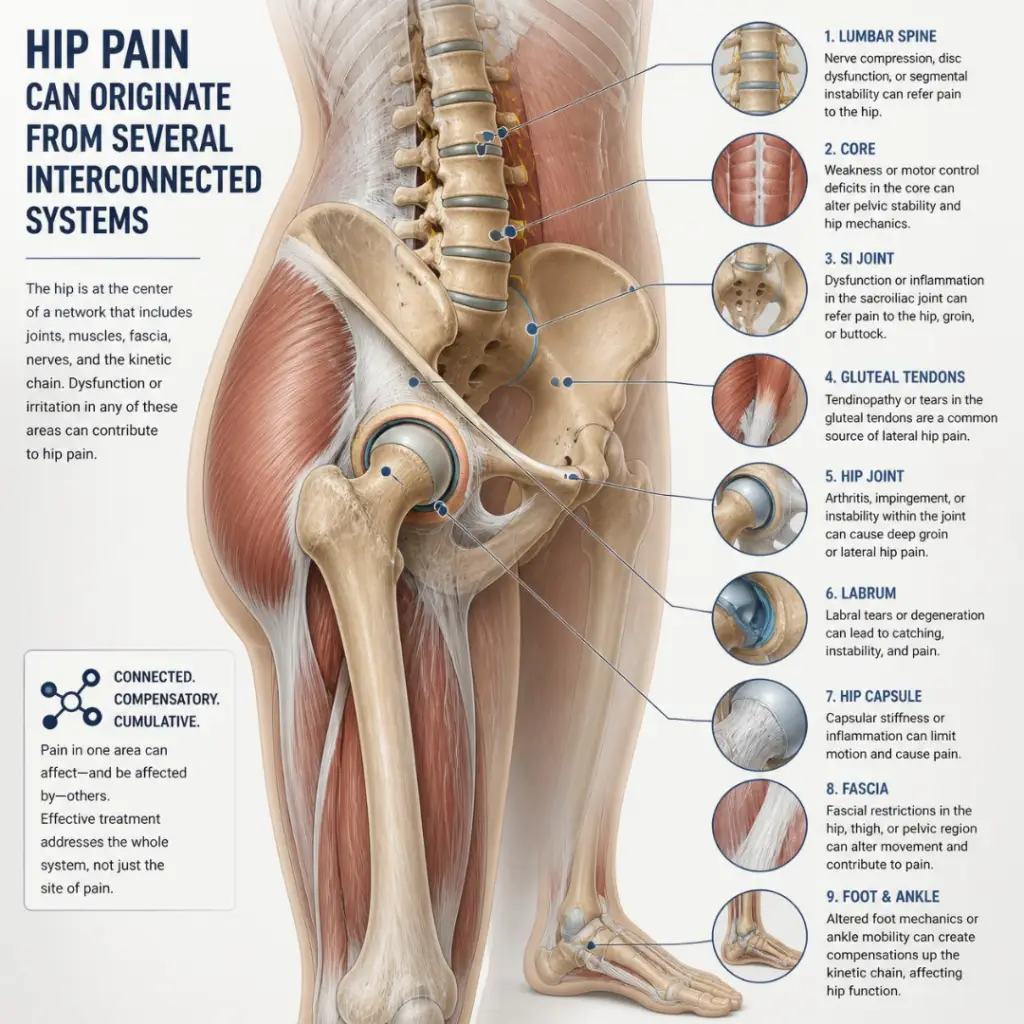
The hip is surrounded by joints, muscles, tendons, ligaments, bursae, nerves, fascia, and other structures capable of producing pain. The lower back, sacroiliac joint, pelvis, and even certain abdominal or pelvic structures can also refer discomfort into the area people commonly describe as “the hip.”
This is why two people pointing to nearly the same painful area can have completely different problems.
One person may have irritation inside the hip joint. Another may have a gluteal tendon problem. Someone else may have pain referred from the lumbar spine. A fourth person may have several overlapping problems occurring at the same time.
The first step is not simply asking, “What diagnosis do I have?”
A better question is:
What combination of tissues, movements, loading patterns, and health factors is producing my symptoms?
Where Do You Feel the Pain?
The location of your pain can provide useful clues. It should not be used as a diagnosis by itself, but it can help narrow the possibilities.
Pain in the Front of the Hip or Groin
Pain in the groin or front of the hip is more commonly associated with structures inside the hip joint. Possible causes include:
- Hip osteoarthritis
- Femoroacetabular impingement
- A hip labral injury
- Irritation of the hip flexor or iliopsoas
- An adductor injury
- A stress injury involving the femur or pelvis
People with joint-related hip pain may notice discomfort when putting on shoes, getting in and out of a car, squatting, pivoting, or bringing the knee toward the chest.
The hip may also feel stiff after sitting or first thing in the morning.
However, groin pain does not always come from the hip joint. Lower lumbar problems, abdominal conditions, hernias, and pelvic-floor dysfunction can sometimes create symptoms in the same region.
Pain Along the Outside of the Hip
Pain over the outside of the hip is often called hip bursitis. The bursa is a small fluid-filled structure that helps reduce friction around the hip, and it can certainly become irritated.
But the bursa is not always the primary problem.
Many cases of lateral hip pain involve the tendons of the gluteus medius or gluteus minimus. These tendons help control the pelvis when you walk, climb stairs, or stand on one leg. Gluteal tendinopathy is now recognized as an important local source of lateral hip pain—not simply an incidental finding. Research review on gluteal tendinopathy
You may notice pain while lying on the affected side, standing with most of your weight on one leg, walking up hills, or climbing stairs.
The position of the pelvis and the way the leg moves beneath it can repeatedly compress or overload these tissues. That means treating only the painful spot may provide temporary relief without changing why the area became irritated.
Pain in the Buttock or Back of the Hip
Pain in the buttock may originate from:
- The hip joint
- The lumbar spine
- The sacroiliac joint
- The deep gluteal muscles
- The hamstring attachment
- Local nerves
- The pelvic floor
It is tempting to label all buttock pain as piriformis syndrome, but that can oversimplify the problem.
Pain arising from the hip joint can also be referred into the buttock. In one study examining pain patterns following diagnostic hip-joint injections, the buttock was actually the most commonly reported referral area. Study of hip-joint pain referral patterns
The lower back can create buttock, groin, thigh, and even knee symptoms that resemble a hip disorder. Conversely, a painful or restricted hip can cause the lower back to compensate.
This overlap is one reason a good hip evaluation should include the lumbar spine and pelvis.
Common Causes of Hip Pain
The following conditions are common, but the presence of one does not mean it is the only contributor to your symptoms.
Hip Osteoarthritis
Hip osteoarthritis involves changes to the cartilage, bone, and other tissues within the joint. X-rays may show joint-space narrowing, bone spurs, changes in bone shape, or more advanced degeneration.
These findings are real. However, the amount of change visible on an X-ray does not always perfectly match the amount of pain or disability a person experiences.
Some people with significant arthritis remain active. Others with comparatively mild imaging changes experience considerable pain.
This doesn’t mean arthritis should be ignored. It means the X-ray should be interpreted alongside your symptoms, hip motion, strength, walking pattern, activity tolerance, and overall health.
Exercise is one of the nonsurgical treatments supported in the American Academy of Orthopaedic Surgeons’ clinical guideline for symptomatic hip osteoarthritis. AAOS hip osteoarthritis guideline
The right program may improve strength, function, confidence, and tolerance for activity even though it cannot erase arthritis from an X-ray.
Femoroacetabular Impingement
Femoroacetabular impingement, usually called FAI, describes a situation in which the shape and movement of the ball-and-socket joint can bring the femur and acetabulum into contact.
Some people have more bone around the femoral head-neck junction, known as a cam shape. Others have greater acetabular coverage, sometimes called a pincer shape. Some people have elements of both.
But bone shape is only part of the equation.
The position of the pelvis, available hip rotation, muscular control, activity demands, and the way the femur moves within the socket can all influence whether that shape becomes symptomatic.
FAI may produce groin pain during deep squatting, prolonged sitting, pivoting, or activities that repeatedly bring the hip into flexion and rotation. It can also place stress on the hip labrum and adjacent cartilage.
Hip Labral Tears
The labrum is a ring of fibrocartilage around the edge of the hip socket. It helps deepen the socket, distribute pressure, and maintain the joint’s fluid seal.
A labral tear can cause pain, clicking, catching, or a feeling that the hip is unstable. But a tear seen on an MRI is not automatically the cause of a person’s pain.
In one study, MRIs identified abnormalities in 73% of hips belonging to people without hip symptoms. Labral tears were found in 69% of the joints examined. Study of asymptomatic hip MRI findings
Other studies have reported different percentages depending on the population and imaging method, but the larger lesson remains the same: structural findings can exist without symptoms.
Your MRI matters, but it must be matched with your history, examination, symptom behavior, and functional limitations.
The goal is not to ignore the tear. The goal is to determine whether it is likely to be the dominant pain generator, one contributor among several, or an incidental finding.
Hip Bursitis and Gluteal Tendon Pain
Lateral hip pain is frequently attributed to an inflamed bursa. In many cases, the gluteal tendons and the surrounding tissues are also involved.
The important question is not simply whether the bursa is irritated. We also need to ask why the tissues on the outside of the hip are being compressed or overloaded.
Possible contributors include:
- A sudden increase in walking or exercise
- Reduced hip-abductor capacity
- Poor pelvic control during single-leg support
- Habitually standing with the hip pushed to one side
- Sleeping positions that compress the outside of the hip
- Changes in walking mechanics
- Limited movement elsewhere in the kinetic chain
Repeatedly rubbing or treating the sore area without addressing these factors may aggravate the tissues rather than resolve the problem.
Could the Pain Be Coming From Your Back?
The hip and lumbar spine share overlapping areas of pain referral.
A lumbar problem does not always create obvious back pain. In some cases, the primary symptom may be felt in the buttock, groin, thigh, or leg. People who have both hip and lumbar conditions can experience very similar symptom patterns. Review of hip and lumbar-spine differentiation
Clues that the spine may be contributing include:
- Symptoms that travel below the hip
- Numbness, tingling, burning, or electrical sensations
- Pain that changes substantially with spinal position
- Symptoms associated with coughing or sneezing
- Weakness that cannot be explained by pain alone
- Pain that improves when sitting but worsens with prolonged standing or walking
These clues are not definitive. Hip osteoarthritis, for example, can also cause pain into the thigh or knee. This is why examining one painful location in isolation may lead to the wrong conclusion.
The Hip Does Not Work Alone
The hip is a ball-and-socket joint, but it does not move independently of the rest of the body.
The socket is part of the pelvis. The pelvis is influenced by the lumbar spine, sacrum, abdominal wall, pelvic floor, and muscles connecting it to the trunk and legs.
Below the hip, the foot and ankle help determine how force enters the body. Above the hip, the trunk influences how force is transferred and controlled.
Imagine the hip as the middle link in a chain.
If the ankle does not bend well during walking or squatting, the foot may turn outward, the knee may change direction, or the hip may be forced to find movement somewhere else.
If the pelvis cannot remain controlled while standing on one leg, the femur may move differently inside the socket and the tissues on the outside of the hip may be exposed to greater compression.
If the lumbar spine is stiff, painful, or poorly controlled, the hip may have to create extra movement. The reverse can also happen: a stiff hip may force the lower back to move more.
This does not mean every hip problem comes from the feet or spine. It means the hip should be evaluated in the system in which it actually functions.
Mobility Is Not Always the Answer
When a hip feels tight, most people assume it needs to be stretched.
Sometimes that is true. Sometimes it is exactly the wrong approach.
A muscle can feel tight because it is shortened, but it can also feel tight because it is fatigued, overloaded, protecting an irritated joint, or attempting to stabilize an area that lacks control.
Aggressively stretching into hip impingement, joint irritation, tendon compression, or instability may make symptoms worse.
The more useful question is not, “Is my hip tight?”
It is:
Which movement is limited, why is it limited, and what happens when we try to change it?
One person may need more hip rotation. Another may already have plenty of motion but lack the strength to control it. Someone else may need improved movement at the ankle, pelvis, or spine so the hip is not repeatedly forced into the same compensation.
Mobility and stability are not opposites. Healthy movement requires enough mobility to reach a position and enough stability to control that position.
Why Imaging Alone Cannot Give You the Entire Answer
X-rays and MRIs are valuable tools. They can identify arthritis, fractures, bone abnormalities, tendon injuries, labral changes, and other conditions that may influence treatment.
But an image is a picture of structure. Pain is an experience produced by a living nervous system responding to tissue health, loading, inflammation, previous injury, sleep, stress, expectations, and many other factors.
Imaging also captures changes that may not be painful.
This is especially important with labral tears and other age- or activity-related findings that appear in people without symptoms. The presence of an abnormality increases the number of questions we should ask; it does not always end the investigation.
A useful interpretation should ask:
Does the finding match the location of your pain? Does it match the movements that provoke symptoms? Are there examination findings pointing toward the same structure? Does the severity of the finding fit your functional limitations? Are there competing explanations?
Imaging should contribute to the diagnosis—not replace clinical reasoning.
What a Comprehensive Hip Evaluation Should Examine
A good assessment begins with your story.
When did the pain begin? Was there an injury or did it develop gradually? Which movements provoke it? What makes it better? How has it changed? What activities have you stopped doing?
Research supports the importance of patient history in differentiating causes of hip pain, sometimes finding it more diagnostically useful than individual objective tests. Study on patient history and hip diagnosis
The physical examination should then test the most plausible explanations.
That usually means evaluating more than whether the hip is “tight.” Depending on the symptoms, the assessment may include:
- Hip rotation, flexion, extension, and side-to-side differences
- Strength and coordination around the hip and pelvis
- Walking, squatting, stepping, and single-leg control
- Lumbar-spine and sacroiliac-joint involvement
- Foot and ankle mechanics
- Neurological signs such as sensation, reflexes, or weakness
- The response to specific movements and repeated loading
No single orthopedic test can perfectly identify every source of hip pain. The goal is to look for a consistent pattern across your history, symptoms, movement, and examination.
When Hip Pain Needs Medical Evaluation
Most hip pain is not an emergency, but certain symptoms deserve prompt medical attention.
Seek appropriate medical evaluation following significant trauma, especially if you cannot bear weight. You should also be evaluated for severe or rapidly worsening pain, a visibly deformed joint, fever or signs of infection, unexplained weight loss, a history of cancer accompanied by new persistent pain, or symptoms suggesting a fracture.
New bowel or bladder changes, numbness in the saddle area, or progressive neurological weakness require urgent medical evaluation because they may indicate serious nerve involvement.
Persistent night pain should be interpreted carefully. Hip and tendon problems often hurt when lying on the affected side, but pain that is constant, unexplained, worsening, or unrelated to position or movement deserves further investigation.
Treatment Should Match the Person, Not Just the Diagnosis
Two people with the same diagnosis may need different plans.
One person with hip osteoarthritis may primarily need graded strengthening and a strategy for rebuilding walking tolerance. Another may have severe joint restriction and functional loss that justifies discussing joint replacement.
One person with a labral tear may respond well to improving hip control and modifying aggravating positions. Another may have persistent mechanical symptoms and structural damage that warrant an orthopedic opinion.
One person with lateral hip pain may need to temporarily reduce tendon compression. Another may mainly need progressive loading so the gluteal tendons can tolerate walking, stairs, and exercise again.
The diagnosis provides context. It should not become a cookie-cutter prescription.
A useful plan should consider the tissue involved, the irritability of the condition, your current capacity, your goals, and the mechanical demands of your daily life.
Pain Relief Is Only the First Step
Reducing pain matters. Pain can interfere with sleep, movement, work, exercise, and confidence.
But temporary pain relief does not always mean the underlying problem has been resolved.
Medication, injections, massage, and other treatments may help calm symptoms. That can create an opportunity to move and exercise more comfortably. The longer-term goal, however, is usually to improve the body’s capacity to tolerate the activities that matter to you.
That may involve restoring useful mobility, improving strength, changing how force is distributed, gradually rebuilding activity tolerance, and giving irritated tissues enough time to adapt.
The objective is not merely to make the hip feel better while you are lying on a treatment table.
It is to help the hip function better when you walk, climb stairs, exercise, sleep, work, and live your life.
The Bottom Line
Hip pain is rarely solved by looking at one structure in isolation.
The location of your pain provides clues. Your diagnosis and imaging can provide additional information. But the most useful answer usually comes from connecting those findings with how your hip moves, how your body manages force, what activities provoke symptoms, and what the surrounding joints and tissues are doing.
Your arthritis may be relevant without explaining everything.
Your labral tear may be real without automatically requiring surgery.
Your bursitis may be painful without being the original cause of the problem.
And the pain you call “hip pain” may sometimes be influenced by the lumbar spine, sacroiliac joint, pelvis, foot, or ankle.
The goal is not to dismiss the painful structure. It is to understand it within the larger system.
If your hip pain is persistent, limiting your activity, or leaving you unsure about what to do next, a comprehensive assessment can help determine what is contributing to the problem and which steps are most appropriate for you.
At Colorado Hip Pain, we evaluate more than the painful location. We look at the hip, pelvis, spine, foot, ankle, strength, mobility, and movement patterns that may be influencing your symptoms. From there, we build an individualized plan designed to help you move out of pain and back toward performance and longevity.
