
Hip Osteoarthritis

Move Freely Again

Hip Osteoarthritis: Symptoms, Causes, and Treatment Options

Hip osteoarthritis is a degenerative joint condition involving changes to the cartilage, bone and other structures of the hip. It can cause groin pain, stiffness and reduced mobility, but the amount of arthritis seen on an X-ray does not always correspond directly with how much pain or limitation a person experiences.

What Is Hip Osteoarthritis?

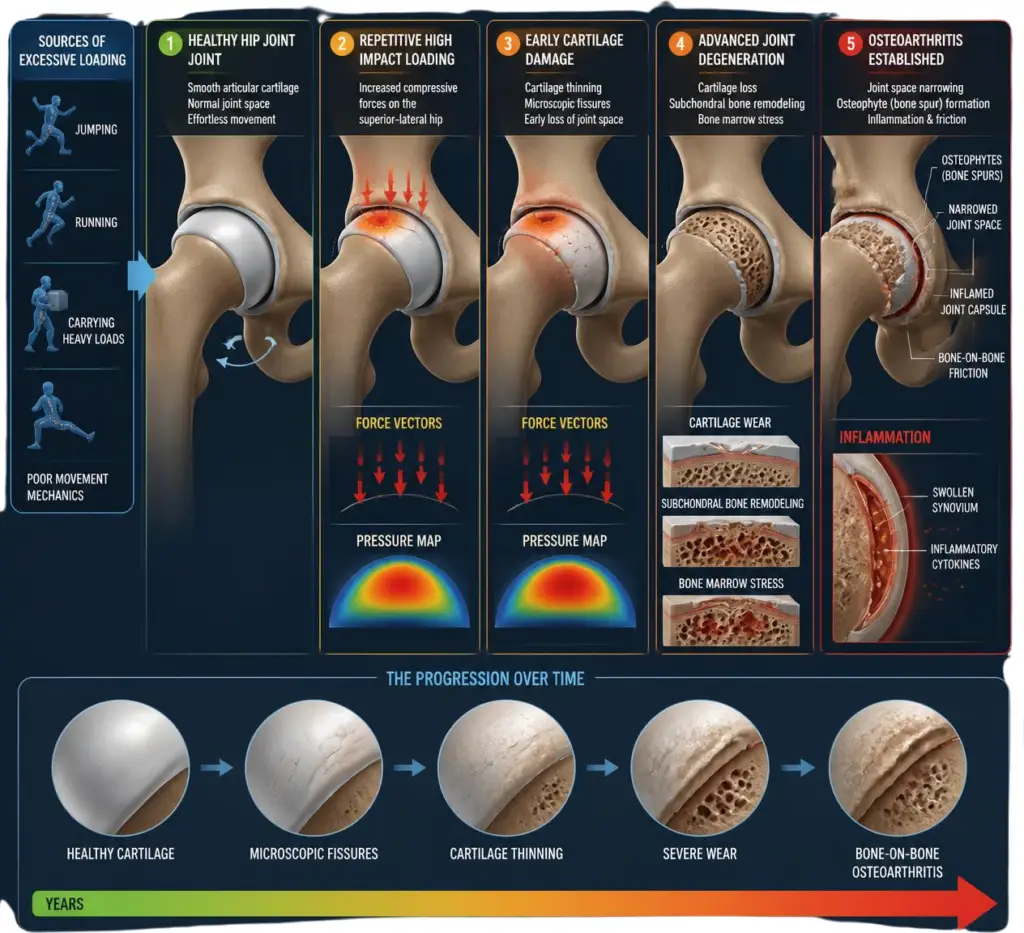
Hip osteoarthritis is a degenerative joint condition involving changes to the tissues within and around the hip joint. The hip is a ball-and-socket joint. The rounded head of the femur fits into the acetabulum of the pelvis, allowing the hip to move through multiple directions. The joint surfaces are normally covered with cartilage that helps the bones move smoothly against one another. With osteoarthritis, changes can occur in the cartilage, bone, joint capsule, and surrounding tissues. Hip osteoarthritis can develop gradually, and symptoms can vary considerably from person to person. Importantly, the amount of structural change seen on an X-ray does not always perfectly predict how much pain someone experiences. That is one reason we look beyond imaging and evaluate how the entire body moves.

What Does Hip Osteoarthritis Feel Like?

Hip arthritis symptoms can develop gradually and may initially seem like normal stiffness or soreness.

Common symptoms include:

  • Pain in the groin
  • Pain at the front of the hip
  • Pain around the outer hip
  • Buttock discomfort
  • Hip stiffness
  • Reduced range of motion
  • Difficulty putting on socks or shoes
  • Pain getting out of a chair
  • Pain getting into or out of a car
  • Difficulty walking longer distances
  • Pain climbing stairs
  • Difficulty squatting
  • Pain during exercise
  • Reduced ability to rotate the hip
  • Stiffness after sitting
  • Increasing difficulty performing activities you enjoy

Hip osteoarthritis pain may also be felt in the thigh or knee, which can make identifying the source of the problem more complicated.

Why Does Hip Arthritis Hurt?

Osteoarthritis is more than simply “wear and tear.”As the hip changes, the joint and surrounding tissues can respond to altered loading and movement. Changes in mobility, muscle strength, coordination, and activity levels can also influence how much stress is placed on the hip. For example, reduced hip mobility may cause the pelvis, spine, knee, or foot to compensate during walking or exercise. Over time, these compensations can change how forces move through the body. That’s why two people with similar hip X-rays may experience very different symptoms.

Your imaging tells part of the story. Your movement tells the other part.

Common Risk Factors for Hip Osteoarthritis

Hip osteoarthritis can affect people for many different reasons.

Factors associated with hip OA may include:

  • Increasing age
  • Previous hip injury
  • Previous surgery
  • Hip dysplasia or structural differences
  • Previous fractures
  • Repetitive joint loading
  • High levels of certain physical activities
  • Previous athletic injuries
  • Muscle weakness
  • Reduced mobility
  • Body-weight-related joint loading
  • Genetics and individual anatomy

Having one or more risk factors does not mean you will develop painful hip osteoarthritis.

Hip Osteoarthritis Doesn't Look the Same in Everyone

One of the biggest mistakes people make is assuming that an osteoarthritis diagnosis tells them exactly what they should do. It doesn’t. Someone with hip OA who wants to return to golf may need a different strategy from someone whose primary goal is walking comfortably around the neighborhood. A former athlete may need to rebuild strength and rotational capacity. Someone preparing for surgery may need to improve strength and movement capacity before the procedure. Someone trying to delay surgery may need a progressive strategy for maintaining mobility, strength, and activity.

Your treatment should reflect your body, your symptoms, and your goals.

Can Hip Osteoarthritis Be Treated Without Surgery?

In many cases, hip osteoarthritis can be managed conservatively with strategies designed to improve function and manage symptoms.

Conservative care may include:

  • Exercise
  • Strength training
  • Mobility training
  • Weight-management strategies when appropriate
  • Activity modification
  • Manual therapy
  • Education
  • Movement retraining
  • Balance and coordination training
  • Home exercise programs

Conservative treatment does not reverse structural osteoarthritis, but it can help many people improve their ability to move and participate in daily activities.

At Colorado Hip Pain, we focus on identifying the factors that may be contributing to your limitations and building your capacity gradually.

What Exercises Should You Avoid With Hip Osteoarthritis?

There is no single “best exercise” for everyone with hip arthritis.

An appropriate program may include combinations of:

Hip Strengthening

Progressive strengthening can help improve the capacity of the muscles surrounding the hip and pelvis.

Mobility Exercises

Maintaining available hip and surrounding joint mobility can make everyday movements easier.

Segmental Strengthening

Rather than treating the body as one large unit, segmental strengthening focuses on improving control and strength in specific regions and movement patterns.

Balance and Coordination

Walking, stairs, sports, and other activities require the nervous system to coordinate multiple joints simultaneously.

Functional Strength

Exercises can be selected around the activities that matter most to you—whether that’s hiking, golf, gardening, travel, or simply moving comfortably through your day.

The right exercise program should be progressive and individualized, rather than based on a generic list of hip arthritis exercises.

Can Massage Help Hip Osteoarthritis?

Manual therapy and massage may be useful components of a comprehensive program for some people with hip pain.

They may help address soft-tissue restrictions, temporarily reduce discomfort, and improve the experience of movement.

However, passive treatment alone does not necessarily address the factors that contributed to reduced strength, mobility, or movement capacity.

That’s why our approach combines manual therapy with active movement strategies.

The goal is not to make you dependent on treatment. The goal is to help you build greater capacity between treatments.

Our Integrative Approach to Hip Arthritis

Depending on your individual needs, your program may incorporate:

Manual Therapy

Targeted hands-on techniques designed to address soft-tissue and mobility restrictions.

Corrective Exercise

Exercises selected around your specific movement limitations and goals.

ELDOA

Specific postural and myofascial exercises designed to improve segmental organization and movement awareness.

Segmental Strengthening

Progressive strengthening focused on specific regions and movement patterns.

Mobility Training

A structured approach to maintaining or improving available movement.

Home Programming

Simple strategies that allow you to continue working on your goals between appointments.

Progressive Strength Training

Building the physical capacity necessary for the activities you want to continue doing.

Frequently Asked Questions About Hip Arthritis

Does hip arthritis on an X-ray always mean the arthritis is causing my pain?

No. An X-ray can show structural changes associated with hip osteoarthritis, but it cannot tell us exactly how much pain those changes are causing. Some people have significant arthritis on imaging with relatively manageable symptoms, while others experience substantial pain and limitations with less dramatic findings.Imaging is most useful when considered alongside your symptoms, hip mobility, strength, activity tolerance and physical examination. This is why understanding the true source of hip pain often requires looking beyond the X-ray alone.

Where is hip osteoarthritis pain usually felt?

Hip osteoarthritis commonly causes pain in the groin or front of the hip, but pain can also be felt in the buttock, outside of the hip, thigh or even around the knee.Pain location provides useful clues, but it does not establish the diagnosis by itself. Several hip conditions—as well as problems originating from the lower back—can create overlapping symptoms. Understanding where your hip pain is coming from requires considering both the location of the pain and what activities or movements provoke it.

Is walking good for hip osteoarthritis?

Yes, walking can be beneficial for many people with hip osteoarthritis. Walking provides regular movement and loading of the hip while helping maintain strength, cardiovascular fitness and the ability to perform everyday activities.The important variable is dosage. If a two-mile walk significantly aggravates your symptoms, that does not necessarily mean walking is bad for your hip. You may simply need to temporarily reduce the distance, pace, terrain or frequency and gradually rebuild your walking capacity

Can I strength train with hip osteoarthritis?

Yes. Hip osteoarthritis does not automatically mean you should stop strength training. Maintaining or improving the capacity of the muscles surrounding the hip can support walking, stairs, balance and recreational activities.The key is matching the exercise to your current capacity. Range of motion, resistance, volume and exercise selection can all be modified. An exercise that is painful today is not necessarily permanently off-limits. The goal is to progressively increase what your hip can tolerate rather than avoiding loading altogether.

Can hip arthritis cause knee pain?

Yes. Hip osteoarthritis can sometimes produce referred pain into the thigh or around the knee, even when the knee itself is not the primary source of the symptoms.This is one reason an assessment should not focus only on the location where pain is felt. If knee pain occurs along with groin discomfort, hip stiffness, reduced hip motion or difficulty walking, the hip may need to be considered as part of the evaluation. Hip pain can be felt in several different locations, not just directly over the hip joint.

When should I consider a hip replacement?

Hip replacement is generally considered when hip osteoarthritis significantly affects pain, mobility, sleep, daily activities or quality of life and appropriate nonsurgical strategies are no longer providing sufficient relief.The decision should not be based on an X-ray alone. Your symptoms, functional limitations, overall health, activity goals and response to conservative treatment all matter. For some people, conservative management can maintain good function for years. For others, joint replacement eventually becomes the most appropriate option.

Scroll to Top